
During July and August, homeowners across Buffalo Avenue in Niagara Falls, NY, begin hearing the same unsettling sound a loud, explosive crack followed by a massive tree limb crashing into a yard, driveway, roof, or street. Surprisingly, these dangerous branch failures almost always happen during calm weather without a single gust of storm wind, forcing residents to scramble for immediate emergency tree service.
Across older, historic neighborhoods flanking the Niagara River corridor, mature shade trees are carrying their heaviest foliage loads of the year. When you combine intense regional humidity, aging hardwood, hidden internal decay, and sudden summer heat stress, large branches fail under pressure. Local arborists refer to this phenomenon as summer limb drop, and it becomes a severe safety hazard during peak summer weather conditions.
For homeowners living along Buffalo Ave, understanding why tree branches fall in summer is critical for preventing catastrophic property damage, severe injury risks, and costly emergency tree removal situations.
What Is Summer Limb Drop?
Summer limb drop is the sudden, unexpected failure of large, mature tree branches during hot-weather months, typically occurring during calm or mildly windy conditions. Unlike winter tree damage caused by heavy snow or ice accumulation, summer branch failures are strictly linked to internal structural stress, moisture imbalances, and excessive canopy weight.
Instead of looking at complex physics formulas, think of a tree limb as a cantilevered beam. As a tree reaches full foliage in mid-summer, its limbs support thousands of moisture filled leaves. This additional mass dramatically increases the downward gravitational force on already stressed branches. If a large limb contains hidden internal decay, weak V-shaped crotches, or age-related wood deterioration, it will eventually crack and collapse without warning.
Expert canopy management teams frequently observe summer limb drop in specific local species, including:
- Silver Maple Trees (Highly prone to brittle wood splits)
- Norway Maples (Commonly suffer from included bark at branch unions)
- Mature Oak Trees (Hold massive, heavy horizontal limbs)
- Ash Trees (Weakened by historical Emerald Ash Borer damage)
- Willow and Large Hardwood Shade Trees
Many of these exact species form the historic, mature tree canopy shading older residential properties across the Buffalo Avenue corridor.
Why Tree Branches Are Snapping in July
Many Niagara Falls property owners assume large branches only pose a threat during severe severe summer thunderstorms. In reality, July is one of the most active months for dangerous limb failures because urban trees are operating under maximum environmental stress.
Several hyper-local factors contribute directly to tree branches snapping in July:
1. Heavy Summer Canopies Create Extreme Weight Stress
By midsummer, regional tree canopies become extraordinarily dense. Leaves continuously absorb and hold surface moisture from high Niagara River humidity, heavy seasonal rainfall, thick morning dew, and residential irrigation systems.
This retained moisture adds hundreds of pounds of dead weight to a single limb. Large horizontal branches extending over roofs, fences, and sidewalks experience continuous gravitational leverage throughout the day. Older wood fibers eventually reach an absolute breaking point, resulting in:
- Sudden branch collapse in calm, windless weather
- Large limbs falling overnight when temperatures shift
- Immediate needs for emergency tree cutting on Buffalo Ave
In many older Niagara Falls neighborhoods, mature trees planted decades ago carry oversized, overextended canopies that have never undergone professional structural weight reduction.
2. Extreme Heat and Humidity Weaken Internal Wood Stability
Hot Western New York summer temperatures place immense vascular stress on mature trees. During prolonged July heatwaves, trees struggle to regulate transpirational water pull. Wood fibers can dry out internally while the outer layers remain moisture-heavy due to oppressive humidity.
This rapid internal moisture imbalance alters the cell pressure within the wood, weakening its overall structural integrity. The Niagara Falls climate accelerates this because:
- Humidity levels remain consistently high near the river.
- Sudden afternoon temperature spikes occur frequently.
- Compact urban soils along Buffalo Ave restrict healthy root expansion and water absorption.
Even a visually flawless, green tree can develop invisible internal pressure fractures beneath its bark during a heatwave.
3. Hidden Internal Decay Makes Structural Limbs Hazardous
One of the greatest dangers with a hazardous tree limb is that internal decay is often impossible for a homeowner to detect from the ground. A massive branch may appear perfectly healthy, vibrant, and green on the outside while internally suffering from:
- Hollow cavities and rotting heartwood
- Fungal wood-decay organisms
- Active carpenter ant colonization
- Included bark and weak structural attachments
This hidden hollow space drastically reduces the branch’s ability to support heavy summer canopy weight. Many emergency tree removal calls in Niagara County involve trees that property owners thought were structurally sound just days prior.
4. Poor Historical Pruning Practices
Improper, uncertified trimming is a major catalyst for summer limb failure. Many local trees have historically been subjected to poor maintenance practices, such as “tree topping,” uneven canopy cuts, or flush cuts that never healed properly.
These practices encourage the rapid growth of weak epicormic sprouts (water sprouts). These new branches grow quickly but have incredibly weak, shallow attachments to the main trunk. Once they develop heavy summer foliage, they act like weighted levers, snapping easily under summer heat stress.
Why Buffalo Avenue Yards Are Especially Vulnerable
Properties throughout the Buffalo Avenue area contain some of the oldest, largest residential tree specimens in Niagara Falls. While these grand trees provide immense curb appeal, property value, and shade, their aging structures present unique risks during the peak of summer.
Local risk factors include:
- Tight Residential Spacing: Large limbs hang directly over roofs, power lines, and neighboring driveways.
- Decades of Unchecked Growth: Many canopies have not been thinned or balanced in over a decade.
- Urban Soil Compaction: Sidewalks, streets, and driveways compress root zones, limiting a tree’s natural stability and nutrient intake.
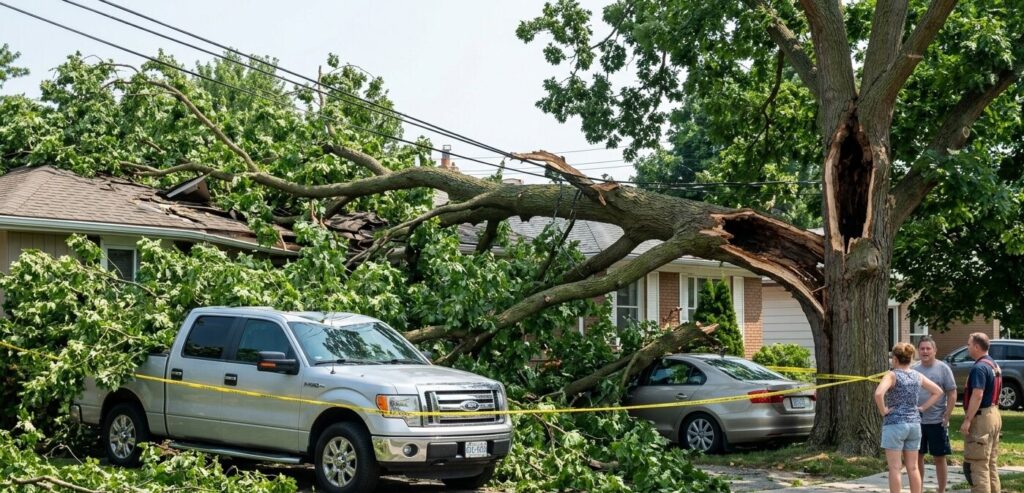
Warning Signs of a Hazardous Tree Limb
Homeowners should proactively inspect their mature trees every June and July. Early detection is the only way to avoid catastrophic property damage. Look closely for these key warning signs:
- Fresh Cracks or Fractures: Look closely near major branch unions and trunk connections.
- Bark Splitting or Seeping: Deep, vertical cracks in the bark exposing bare wood underneath.
- Internal Hollows or Fungi: Conks, mushrooms, or brackets growing directly on limbs or at the base of the tree.
- Excessive Branch Sagging: A low hanging limb that sits significantly lower than it did in the spring.
- Localized Deadwood: One specific branch completely losing its leaves while the rest of the canopy remains green.
If you observe any of these red flags, scheduling a professional hazardous tree limb assessment is highly recommended before the next major humidity spike.
Why Emergency Tree Cutting Should Never Wait
Once a large branch fractures internally, its condition can deteriorate rapidly. A partially cracked limb may hang precariously in the canopy for hours or days before completely collapsing due to a minor afternoon breeze, a sudden rain shower, or overnight cooling shifts.
Attempting to cut a compromised, hanging limb yourself is incredibly dangerous. These branches remain under intense mechanical tension and can twist, kick back, or drop unpredictably the moment a chainsaw makes contact.
Partnering with professional emergency tree cutting crews ensures that:
- Unstable hanging branches are safely rigged, lowered, and removed without hitting your roof.
- Secondary structural damage to your home, vehicles, and utility lines is prevented.
- The remaining tree canopy is properly assessed to ensure the entire tree isn’t at risk of a total failure.
How Preventative Tree Trimming Reduces Summer Limb Drop
The most cost-effective way to protect your property from sudden branch failure is routine, proactive canopy maintenance. Waiting until a branch falls usually results in expensive emergency fees, home insurance deductibles, and landscape damage.
Strategic, professional pruning helps mitigate summer limb drop by:
- Canopy Thinning: Reducing excessive leaf mass and moisture weight from horizontal limbs.
- Improving Airflow: Allowing summer winds to pass harmlessly through the canopy rather than acting like a sail.
- Structural Weight Reduction: Carefully cutting back overextended branches to move the center of gravity closer to the trunk.
- Deadwood Removal: Cleaning out weak, decaying, or dead limbs before they can fall on their own.
For Buffalo Ave homeowners, investing in preventative pruning in late spring or early summer is the ultimate insurance policy against the unpredictable hazards of summer limb drop.
Frequently Asked Questions
Why do tree branches fall in summer when there is no wind? Tree branches fall in summer due to a phenomenon called summer limb drop. It occurs when extreme summer heat and high humidity cause a tree’s canopy to retain excessive moisture weight. This immense weight overburdens branches that are already structurally weakened by hidden internal decay, age, or poor pruning, causing them to snap on calm days.
Can a perfectly healthy tree experience summer limb drop? Yes. While trees with internal rot are at higher risk, seemingly healthy trees can experience summer branch failure. Large, overextended limbs on mature trees can simply accumulate more foliage weight than the natural wood fibers can support, leading to a sudden structural fracture under heat stress.
Which specific tree species are most susceptible to summer branch snapping? The tree species most vulnerable to summer limb drop in older residential areas include Silver Maples, Norway Maples, Willows, mature Oaks, and Ash trees. Maples and Willows are particularly susceptible due to their naturally brittle wood structures and rapid growth habits.
When should I call for emergency tree cutting on Buffalo Ave? You should contact an emergency tree service immediately if you see a cracked branch union, a hanging or detached limb caught in the canopy, a branch pressing directly against power lines, or a sudden, severe sag in a large limb overhanging your home or driveway.
How does proactive tree trimming prevent summer limb drop? Proactive tree trimming reduces the overall weight of the upper canopy through selective branch thinning and weight reduction pruning. This drastically lowers the gravitational leverage on main limbs, improves wind filtration, and removes hidden hazardous wood before it can fail.