
Tree Maintenance Niagara Falls NY: How to Keep Trees Healthy and Storm Ready All Year
Trees are one of the most valuable features of any residential property across Niagara County. They provide shade, increase curb appeal, improve air quality, reduce energy costs, and can significantly boost property value. However, maintaining healthy trees in Niagara Falls, NY requires more than occasional trimming.
Between heavy lake-effect snow from Lake Ontario, severe ice storms, strong winds whistling through the Niagara River corridor, summer thunderstorms, and rapid freeze-thaw cycles, Western New York (WNY) trees face constant environmental stress.
Without routine maintenance, even healthy-looking trees can develop hidden structural weaknesses, disease issues, and storm-related hazards that put homes, vehicles, and families at risk.
This comprehensive local guide explains everything homeowners need to know about year-round tree maintenance, preventive pruning, professional arborist inspections, storm preparation, tree health monitoring, and long-term tree preservation in the Niagara Falls region.
Quick Answer: What Is the Best Way to Maintain Trees in Niagara Falls, NY?
The most effective way to maintain trees in Niagara Falls is through a proactive, localized annual maintenance plan. This includes professional arborist inspections, seasonal preventive pruning, canopy management, deep root hydration, and targeted winter storm-prevention strategies.
Key Takeaways
- Schedule Annual Inspections: Catch hidden decay before severe WNY winter weather hits.
- Prioritize Preventive Pruning: Remove hazardous, storm-prone branches before they fail.
- Monitor Local Stressors: Keep a close eye on your canopy after heavy lake-effect snow and high-wind events.
- Address Pests Early: Act quickly against regional threats like the Emerald Ash Borer.
- Invest Proactively: Preventive maintenance is significantly cheaper than emergency storm cleanups and roof repairs.
Why Tree Maintenance Is Especially Important in Niagara Falls, NY
Many online tree care articles provide generic advice that could apply anywhere. However, homeowners in Niagara Falls face unique geographical and climate challenges that require highly localized tree maintenance strategies.
Trees throughout Niagara Falls, Niagara County, and the greater Buffalo-Niagara region are regularly exposed to:
- Heavy Lake-Effect Snow: Heavy, wet snow accumulation that overloads branches.
- Ice Accumulation & Ice Storms: Extreme weight that tests the structural integrity of mature trees.
- Rapid Freeze-Thaw Cycles: Drastic temperature swings that crack bark and stress root systems.
- High Wind Events: Funneled winds along the Niagara River corridor that expose hidden structural defects.
- Saturated Soil Conditions: Spring thaws and heavy rains that destabilize root systems in urban soils.
Our team performing post storm assessments throughout local neighborhoods including LaSalle, DeVeaux, Hyde Park, and Cayuga frequently identify preventable structural defects that could have been addressed years earlier through routine maintenance.
Many emergency tree failures are not caused by a single storm; they are the cumulative result of years of neglected care.
How Niagara Falls Weather Affects Tree Health
Understanding local weather patterns helps homeowners better protect their landscapes.
Lake-Effect Snow & Ice Storms
Niagara Falls experiences significant lake-effect snowfall and sudden ice freezing during winter months. Heavy ice and snow accumulation add substantial weight to branches. Trees with dense, unmanaged crowns are particularly vulnerable. Weak branch unions often fail during these events, leading to fallen limbs, property damage, and severe safety hazards.
Freeze-Thaw Cycles & High Winds
Repeated freezing and thawing can expand existing trunk cracks, damage delicate bark, and increase a tree’s susceptibility to local fungal diseases. Furthermore, strong winds moving through the Niagara corridor frequently expose hidden internal decay. Branches weakened by rot, disease, or poor prior trimming practices are almost always the first to fail.
Common Tree Species Found in Niagara Falls and Their Maintenance Needs
Different tree species across WNY require specialized maintenance strategies.
Maple Trees (Sugar, Silver, and Norway Maples)
Maples are among the most common shade trees throughout Niagara Falls neighborhoods like DeVeaux and LaSalle.
- Common Concerns: Dense canopies, heavy lateral limbs, and high susceptibility to storm splitting.
- Maintenance Focus: Routine crown thinning is essential to improve airflow, reduce wind resistance, and minimize limb stress.
Oak Trees (Red and White Oaks)
Mature oaks provide exceptional canopy value to historic properties but require consistent monitoring.
- Common Concerns: Deadwood accumulation and structural defects hidden by thick foliage.
- Maintenance Focus: Strategic deadwooding and structural pruning to maintain long-term health.
Ash Trees
- Common Concerns: Ash trees remain highly vulnerable to the devastating Emerald Ash Borer (EAB) infestations throughout New York State.
- Maintenance Focus: Regular arborist evaluations to determine if professional preventative treatment or safe removal is required.
Ornamental Trees (Crabapple, Cherry, Dogwood, Redbud)
- Common Concerns: Fungal issues due to local humidity and structural crowding.
- Maintenance Focus: Benefit significantly from routine aesthetic pruning, disease management, and careful seasonal monitoring.
Seasonal Tree Care Checklist for Niagara Falls Homeowners
Following a consistent seasonal schedule helps local trees remain resilient year-round.
Spring Tree Maintenance: The Post-Winter Assessment
Spring is the ideal time to evaluate the toll that winter took on your property.
- Inspect for Winter Damage: Look for broken branches, hanging limbs, bark injuries, new trunk cracks, or exposed roots around your yard. Addressing these early prevents pest infestations.
- Schedule an Arborist Inspection: Professional preventative arborist services can identify structural weaknesses, hidden decay, and early disease symptoms before full leaf-out hides them.
- Apply Fresh Mulch: Maintain a clean mulch ring around the root zone to retain moisture and regulate soil temperature, making sure not to pile mulch against the trunk (avoid “mulch volcanoes”).
Summer Tree Maintenance: Hydration & Tree Health Monitoring
Summer heat and occasional dry spells can stress even mature trees.
- Water Deeply During Dry Conditions: Focus on deep root zone hydration rather than shallow surface watering to encourage strong, deep root systems.
- Tree Health Monitoring: Watch for signs of stress such as yellowing leaves, wilting, premature leaf drop, or branch dieback.
- Inspect for Insects: Check for signs of active aphids, borers, scale insects, or Emerald Ash Borer activity. Early intervention drastically improves treatment success rates.
Fall Tree Maintenance: Emergency Storm Prevention
Fall is the most critical window for preventive tree care before the snow arrives.
- Perform Preventive Pruning: Remove dead, crossing, or weak branches to reduce wind resistance and winter weight load.
- Remove Hazardous Limbs: Identify and professionally prune branches extending directly over homes, garages, driveways, utility lines, or walkways for reliable emergency storm prevention.
- Prepare the Root Zone: Apply late-season watering and mulching to insulate root systems against upcoming sub-zero ground temperatures.
Winter Tree Maintenance: Dormant Pruning & Safety
Winter provides a unique opportunity for major structural improvements.
- Schedule Dormant Pruning: Pruning while the tree is dormant is highly recommended. With leaves gone, structural defects are fully visible, and the risk of transmitting diseases or attracting pests is virtually zero.
- Inspect After Severe Weather: Walk your property safely after heavy lake-effect snow or ice storms to look for split trunks, hanging limbs, or leaning trees.
Tree Pruning vs. Tree Trimming: Understanding the Difference
Many homeowners use these terms interchangeably, but they serve distinctly different purposes for your landscape.
| Feature | Tree Pruning | Storm-Resistant Tree Trimming |
| Primary Focus | Tree health, safety, and long-term structure | Aesthetics, shape, and neat appearance |
| Action Taken | Removes defective, diseased, or dead branches | Controls overgrowth and clears specific boundaries |
| Core Goal | Improves structural integrity and safety | Enhances curb appeal and landscape design |
| Timing | Highly strategic, often preventive | Routine maintenance throughout the year |
While both services keep your property looking pristine, preventive pruning plays the primary role in healthy tree maintenance and storm prevention.
The Importance of Preventive Pruning & Canopy Management
Rather than waiting for a storm to break a limb and damage your roof, proactive canopy management improves a tree’s natural architecture.
Key Benefits of Proactive Pruning:
- Reduces Storm Damage: Selectively removing weak limbs lowers the likelihood of catastrophic failure during high-wind events.
- Improves Airflow and Light Penetration: Proper canopy management reduces humidity within the crown, lowering fungal disease pressure.
- Enhances Structural Integrity: Correcting poor growth patterns early builds a stronger branch architecture over time.
- Protects Surrounding Assets: Safely clears branches away from roofs, siding, gutters, vehicles, and utility lines.
One of the Most Overlooked Tree Defects in Niagara Falls: Included Bark
One of the most common structural issues our team encounters throughout Niagara County is included bark.
Included bark develops when bark grows inward between co-dominant stems (two or more large trunks growing from the same point) instead of forming a strong, welded wood union.
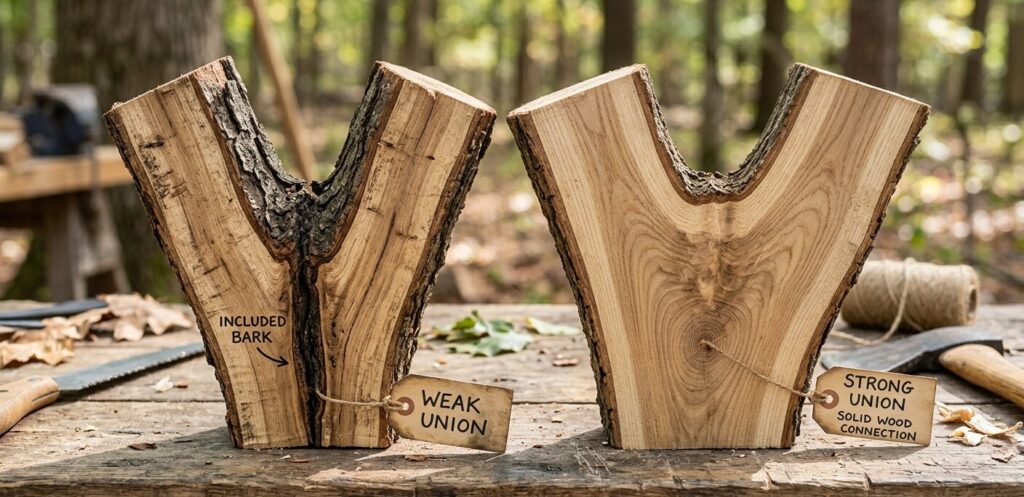
Although these co-dominant stems may appear perfectly stable during calm summer days, they lack the structural fiber connection to hold together under stress. They frequently split completely in half during heavy winter snow or sudden windstorms. Routine professional arborist inspections can catch these hidden hazards early, allowing for preventive structural cabling or selective removal.
What Is a Professional Tree Risk Assessment?
A formal tree risk assessment evaluates the probability of a tree or branch failing and balances that against the potential consequences to surrounding “targets.”
During an assessment, an arborist evaluates three core components:
- Tree Condition: Checking for internal decay, structural stability, growth patterns, and overall biological vitality.
- Site Conditions: Analyzing soil compaction, local drainage issues, recent grade changes, and root space constraints.
- Potential Targets: Evaluating the proximity of structures, power lines, vehicles, sidewalks, and outdoor living spaces.
What Arborists Look for During Professional Inspections
A comprehensive professional inspection involves looking closely at the entire ecosystem of the tree. Arborists look for signs that are often completely invisible to the untrained eye:
- Root Flare Condition: Ensuring the base of the tree isn’t buried or suffering from girdling roots.
- Trunk Integrity: Checking for deep structural cracks, hollow cavities, or seeping wounds.
- Branch Attachment Strength: Evaluating unions for included bark or weak structural angles.
- Internal Decay Indicators: Identifying localized fungal fruiting bodies, mushrooms at the base, or woodpecker activity that signals wood-boring insects.
Common Tree Diseases and Pest Problems in Niagara County
Routine monitoring ensures local threats are addressed before they cause irreversible canopy decline.
- Fungal Diseases (Anthracnose, Apple Scab, Verticillium Wilt): Often triggered by wet, humid WNY spring weather, causing premature leaf spots, blotches, and early defoliation.
- Root Rot (Phytophthora): Poorly drained or compacted urban soils near driveways often trap water, leading to root decay. Symptoms include general canopy thinning and a sudden lean.
- Local Insect Infestations: Outside of the devastating Emerald Ash Borer, homeowners should watch for scale insects, aphids, and wood-boring beetles that structurally weaken timber.
Preventive Maintenance vs. Emergency Tree Service
Many homeowners wait until a severe storm forces them to call for emergency help. However, a comparison of the approaches shows that establishing an annual tree maintenance plan is always the better long-term investment.
| Aspect | Preventive Maintenance | Emergency Tree Service |
| Approach | Planned, stress-free scheduled service | Reactive, high-stress emergency response |
| Financial Cost | Predictable, lower overall maintenance costs | Premium emergency rates and unpredictable costs |
| Property Impact | Protects and preserves existing landscaping | Occurs after property, roof, or vehicle damage |
| Tree Health | Extends the life and beauty of the tree | Often results in complete, unplanned removals |
Signs a Tree May Need Removal Instead of Maintenance
While our primary goal is always tree preservation, certain conditions make removal the safest and most responsible option for protecting your property.
A tree should likely be removed if it exhibits:
- Severe Structural Defects: Over 30–50% of the trunk is hollow or internally decayed.
- Extensive Root Damage: Major structural roots have been severed by construction or damaged by severe rot.
- Advanced Disease or Pest Dieback: The canopy has suffered more than 50% decline from pests like EAB.
- Unacceptable Safety Risks: The tree is leaning significantly toward a home or high-traffic area with clear signs of root lifting.
The Hidden Cost of Delaying Tree Care
Neglecting routine care can lead to serious legal, financial, and safety consequences. Delayed maintenance frequently results in:
- Premium emergency response fees for storm cleanup.
- Expensive residential roof, gutter, and structural siding repairs.
- Damaged vehicles and blocked driveways during severe weather.
- Deductibles and increased premiums from home insurance claims.
- Ruined lawns, flowerbeds, and secondary landscape features from falling limbs.
Why Healthy Trees Are Valuable to Niagara Falls Homeowners
Investing in your trees pays direct dividends. Well-maintained, mature trees significantly enhance residential properties by:
- Boosting overall curb appeal and neighborhood character.
- Increasing perceived property value by up to 10–15%.
- Reducing summer cooling bills by providing direct shade to roofs and windows.
- Supporting local stormwater management by absorbing heavy rainfall.
Niagara Falls Tree Maintenance Checklist at a Glance
| Season | Primary Focus | Key Actions to Take |
| Spring | Damage Assessment & Vitality | Winter inspection, fresh mulching, and pest monitoring |
| Summer | Hydration & Stress Management | Deep watering, canopy health checks, and insect control |
| Fall | Storm Prevention & Safety | Preventive pruning, hazardous limb removal, and winter prep |
| Winter | Structure & Dormant Care | Clear-view dormant pruning and post-snowstorm safety checks |
Frequently Asked Questions
How often should trees be trimmed in Niagara Falls, NY?
Most mature trees benefit from structural trimming and pruning every 3 to 5 years. However, an annual tree maintenance plan involving basic inspections is highly recommended to look for seasonal storm damage, pest infestations, or structural weaknesses before harsh WNY winter conditions set in.
How often should trees be professionally inspected?
Most mature trees should be professionally inspected at least once a year. Trees that are close to your home, hanging over power lines, or showing visible signs of decline should be checked more frequently, especially before the winter storm season.
What is the best time of year for tree pruning?
Late fall through winter is generally the ideal time for structural pruning. Because trees are dormant, the lack of foliage gives arborists a clear view of the branch structure, and the cold weather minimizes the risk of spreading fungal diseases or attracting pests.
Can heavy snow damage healthy trees?
Yes. Heavy, wet lake-effect snow can put immense physical weight on a tree. If a tree has a dense canopy, poor structure, or undetected internal decay, even a healthy-looking limb can snap under the weight of winter accumulation.
What is crown thinning?
Crown thinning is the selective removal of smaller, weaker branches throughout the upper canopy. This process increases light penetration and airflow while reducing the overall weight and wind resistance of the tree without altering its natural shape.
What is deadwooding?
Deadwooding is the targeted removal of dead, dying, or diseased branches from a tree. This is done primarily for safety to prevent branches from falling on people or property and to stop decay or pests from spreading into the healthy parts of the tree.
Can preventive pruning really reduce storm damage?
Absolutely. Preventive pruning removes weak branch attachments, deadwood, and overcrowded limbs before severe weather hits. This allows high winds to pass safely through the canopy rather than catching it like a sail, significantly reducing storm failures.
When should a tree be removed instead of pruned?
Removal is necessary when a tree presents an immediate, unfixable safety hazard such as a completely hollow trunk, severe root rot, or a lean toward a home or when it has lost more than half of its canopy to disease or storm damage.
Are professional arborist inspections worth the cost?
Yes. An expert arborist can spot early signs of internal decay, structural instability, or pest infestations long before they cause obvious damage, saving you from expensive emergency removals and property repairs down the road.
What are the most common signs of tree disease in Niagara County?
Look out for discolored or spotted leaves during the spring and summer, premature leaf drop, dieback at the tips of branches, oozing cankers on the bark, or unusual fungal growths along the trunk.
Why is specialized tree maintenance so critical specifically in Niagara Falls?
Our unique location places us right in the path of intense lake-effect snow, severe ice accumulation, and high winds funneling along the Niagara River corridor. These harsh local conditions create extreme physical stress on trees, making routine, proactive care essential for property safety.
Schedule a Professional Tree Evaluation Before the Next Storm Season Arrives
The best time to address tree hazards is before they turn into emergencies. Whether you are concerned about overgrown branches hanging over your roof, declining canopy health, upcoming winter storm preparation, or potential safety risks near your driveway, a professional tree assessment can identify problems early and help you establish a sustainable, long-term maintenance plan.
By investing in routine inspections, preventive pruning, precise canopy management, and active health monitoring, Niagara Falls homeowners can protect their properties, preserve our beautiful local mature trees, and prevent costly storm damage for years to come.
Need Local Assistance?
If you are located near historic DeVeaux, LaSalle, Hyde Park, or anywhere within the greater Niagara region, visit our Niagara Falls Service Areas page to schedule your comprehensive pre-season tree risk assessment. Keeping your WNY property safe, beautiful, and storm-ready is just a click away.
Disclaimer: Tree maintenance and removal can be highly hazardous. Always consult with a certified, fully insured arborist before undertaking significant structural pruning or high-risk tree work on your property.