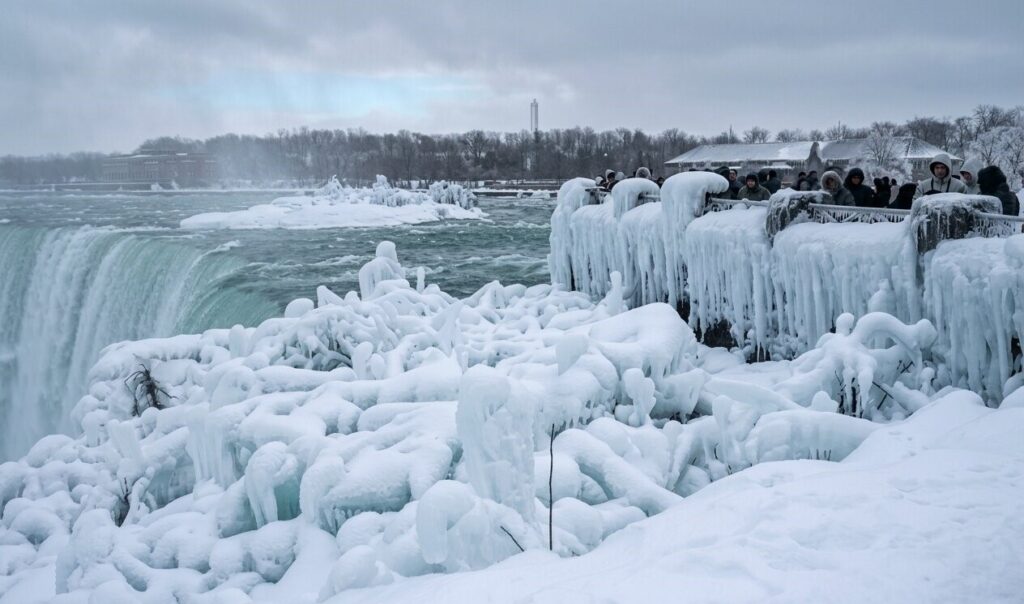
Tree problems along Buffalo Avenue in Niagara Falls are rarely simple landscaping issues. In this older residential corridor running right along the Niagara River, mature urban trees experience constant micro climate stress: heavy wet lake effect snow loads off Lake Erie, relentless high velocity wind shears, and deep seasonal soil saturation.
What appears to be a stable canopy during summer months can rapidly suffer catastrophic structural failure during a harsh Upstate New York winter storm.
If you are currently searching for tree removal Buffalo Avenue Niagara Falls NY, your objective is not just cutting down wood it is high-risk risk mitigation, structural protection of adjacent properties, and executing technical rigging according to ISA (International Society of Arboriculture) safety protocols.
Why Tree Removal Is Common along Buffalo Avenue, Niagara Falls NY
Unlike suburban areas containing younger, flexible growth, historic properties near Buffalo Avenue feature aging urban forests that have sustained decades of environmental damage. The physical laws of wood mechanics determine our local tree failures:
- Lake-Effect Heavy Ice & Snow Accumulation: Heavy, wet winter precipitation puts extreme mechanical load on lateral limbs, exploiting structural defects and tearing apart co-dominant stems.
- River Corridor Torsional Wind Shear: The open waterfront geography near LaSalle and the Niagara River rapids creates a high-wind funnel effect, fracturing brittle heartwood.
- Subsoil Liquefaction & Root Shifting: High local water tables thoroughly saturate the soil matrix. During rapid freeze-thaw cycles, the ground heaves, snapping fine anchoring roots and destabilizing massive trunks.
- Vascular Compartmentalization Failure: Older local populations of silver maples, ashes, and oaks lose their biological ability to wall off internal fungal rot, leading to silent structural decline.
Technical Warning Signs of Imminent Tree Failure
Most property owners identify hazard trees only when failure is already actively developing. Request a professional arborist assessment immediately if you observe any of these critical triggers:
🌲 Sudden Lean vs. Natural Phototropic Growth
A natural growth lean toward open sunlight is structurally sound. However, a sudden lean after heavy rainfall or high wind gusts indicates a catastrophic failure of the root plate. Look closely for freshly mounded earth, heaving soil, or exposed structural roots lifting on the side opposite the lean.
🌲 Co Dominant Trunk Splits & Included Bark
When a tree develops into two main stems of equal size, the bark trapped between them forms a weak union known as included bark. Winter ice storms exploit these structural fault lines, splitting the main trunk wood completely down the center.
🌲 Structural Dieback & Dead Canopy Zones
Large sections of dead, brittle branches in the upper canopy indicate a dying vascular system. These dead limbs lose elasticity rapidly and become high-velocity drop hazards during minor windstorms.
🌲 Basal Fungal Fruiting Bodies & Hollow Cavities
The appearance of Ganoderma or sulfur shelf mushrooms clustering around the root flare or trunk base proves that active wood-decay fungi are destroying the tree’s internal load-bearing heartwood.
Municipal Permits & Local Laws for Niagara Falls Tree Removal
Executing an advanced removal along a major local corridor like Buffalo Avenue requires strict adherence to regional legal frameworks to completely insulate yourself from heavy liability risks:
📋 Local Jurisdiction Boundaries:
- City Right-of-Way (ROW): Any tree located on the public easement strip between the sidewalk and the street curb along Buffalo Ave is under the direct jurisdiction of the City of Niagara Falls Department of Parks & Public Works. Private homeowners cannot prune or remove these trees without explicit city authorization.
- Overhead High-Voltage Utility Clearances: If any portion of your tree’s canopy encroaches within a 10-foot danger zone of primary overhead power lines, your tree service contractor must halt and coordinate with National Grid for formal utility line clearance or temporary line de-energization.
Hazardous Tree Removal Buffalo Avenue NY (Emergency Services)
When a tree’s structural equilibrium is fully compromised, standard scheduling is completely bypassed. Emergency arborist crews prioritize rapid hazard mitigation to secure public pathways and protect human life.
True tree emergencies require an advanced understanding of tension and compression physics, such as uprooted trees resting directly against residential rooflines or split leaders hanging over public sidewalks. To safely stabilize these structures, dispatching an experienced emergency tree service Niagara Falls NY ensures that crews can deploy heavy mechanical advantage systems utilizing high-capacity friction brakes, heavy lowering blocks, and technical high-angle rigging ropes to safely dismantle the hazard cut-by-cut without secondary property impact.
Tree Trimming vs. Complete Removal: The Decision Matrix
Not every damaged tree needs to be cut down completely. Certified crews evaluate the long-term viability of your property’s assets using a strict structural matrix:
| Evaluation Metric | Tree Trimming & Structural Pruning | Complete Tree Removal |
| Canopy Defoliation | Less than 30-40% of the upper crown is damaged; active branch healing is possible. | Greater than 50% canopy dead zones, structural rot, or widespread pest death. |
| Trunk Soundness | Minimal internal hollows; sufficient sound heartwood thickness verified via mallet sounding. | Deep vertical trunk cracks, hollow trunk chambers, or extensive base rot. |
| Root Plate Stability | Root flare is completely anchored; no ground lifting or basal decay. | Severely decayed structural root system; visible soil heaving or tilting. |
Calculating Tree Removal Costs Near Buffalo Ave
Tree removal pricing is never fixed; it is calculated based on the specific physics, risks, and mechanical assets required to handle the timber safely.
- Total Height & DBH (Diameter at Breast Height): Taller trees with wide trunk diameters contain immense physical mass, exponentially increasing the total labor hours and rigging cycles needed.
- Target Proximity & Layout Setbacks: A tree located in an open field is highly efficient to remove. A tree positioned tightly between historic homes, fences, or utility drops near Buffalo Ave requires tedious, slow-speed sectional lowering, which shifts operational costs.
- Mechanical Machinery Assets: If a tree is too structurally decayed to safely support a climbing arborist, the layout demands heavy machinery requiring 75-foot bucket trucks, compact tracked spider lifts, or commercial cranes to lift log sections safely over residential roofs.
Large Oak Tree Removal Cost Niagara Falls
Removing a mature Oak (Quercus) is an incredibly complex, resource heavy operation. Because oak wood possesses massive density and heavy physical weight per cubic foot, these jobs demand oversized commercial chainsaws, heavy duty industrial lowering blocks, and meticulous ground crew coordination to handle the massive drop zones safely, positioning oak removals at the premium tier of local pricing structures.
What Happens During a Professional Tree Removal Operation
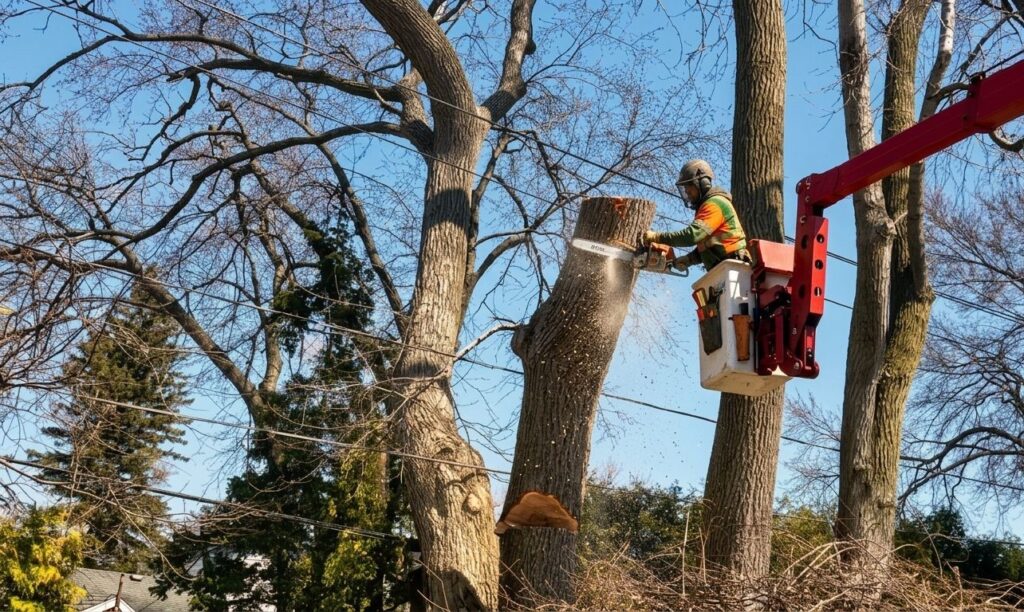
A systematic, safety first tree removal follows five definitive technical phases:
- Site Hazard Assessment: The field crew maps out the tree’s natural weight distribution, identifies underground utilities, and establishes strict drop-zone perimeters.
- Rigging Infrastructure Setup: The climbing arborist mounts high-anchor friction blocks and pulleys to ensure every severed limb remains under mechanical mechanical control from the ground.
- Sectional Canopy Dismantling: Working from the outer canopy downward, branches are systematically cut, balanced, and lowered away from target structures.
- Trunk Breakdown Sequences: The main trunk is sectioned into controlled rounds using precise vertical relief and wedge cuts, safely lowered down using friction braking systems.
- Debris Processing & Stump Grinding: All brush is run through commercial chippers, and high-speed stump grinders grind the remaining root system 6 to 12 inches below grade to allow clean lawn restoration.
Insurance, Safety, and Legal Non Negotiables
Because high-angle arboriculture is inherently hazardous, choosing unverified crews introduces severe legal exposure to the property owner. Always require proof of:
- Comprehensive General Liability Insurance: Fully protects your residential structures, vehicles, and neighboring properties from accidental operational damage.
- Workers’ Compensation Insurance: Completely insulates the private property owner from financial or medical liability if a crew member gets injured on your land.
- ANSI Z133 Safety Compliance: Confirms the team operates under strict national safety standards for professional tree care operations.
FAQ: Tree Removal Buffalo Avenue Niagara Falls NY
Who handles tree removal on the public curb along Buffalo Avenue?
Trees on the public curb strip are managed by the City of Niagara Falls Department of Parks & Public Works. Homeowners must contact the city for maintenance rather than hiring private crews to touch public assets.
How does proximity to overhead wires affect the tree removal process?
If any limb encroaches within the 10-foot safety buffer of power lines, your tree contractor must collaborate directly with National Grid to execute a safe electrical utility clearance before work proceeds.
Can a dying tree be stabilized without full removal?
If the internal heartwood is solid and the root plate is fully anchored, structural pruning, crown reduction, or dynamic cabling systems can sometimes preserve the tree, avoiding full removal costs.
What is included in standard stump grinding services?
Stump grinding is an independent service. It uses a high-powered rotating wheel to turn the below-grade stump into mulch, freeing up land for topsoil and landscaping replanting.
Final Thoughts for Local Property Owners
Proactive tree care is the most effective defense against sudden property emergencies in the Niagara region. Balancing local climate risks like heavy lake effect snow and river wind corridor dynamics requires a professional touch.
Whether you need crane assisted dismantling, routine structural pruning, or immediate emergency storm response, scheduling an inspection with a licensed arborist ensures your home remains secure and your landscape remains safe all year round.