Tree removal Buffalo NY, is required before fall when trees exhibit severe structural decay, sudden leans, deep trunk splits, dead canopy sections, or advanced fungal disease. Proactive removal by an ISA Certified Arborist prevents property damage caused by autumn windstorms and heavy lake effect snow loads across Erie County homes.
Why Buffalo’s Fall Climate Makes Tree Inspection Critical
Buffalo and the surrounding Western New York region experience demanding autumn weather conditions every year.
Unique microclimates fueled by Lake Erie create severe wind vectors across Erie County from late September through November.
Suburban areas like Amherst, Cheektowaga, Tonawanda, West Seneca, and Orchard Park frequently face sudden, aggressive cold fronts.
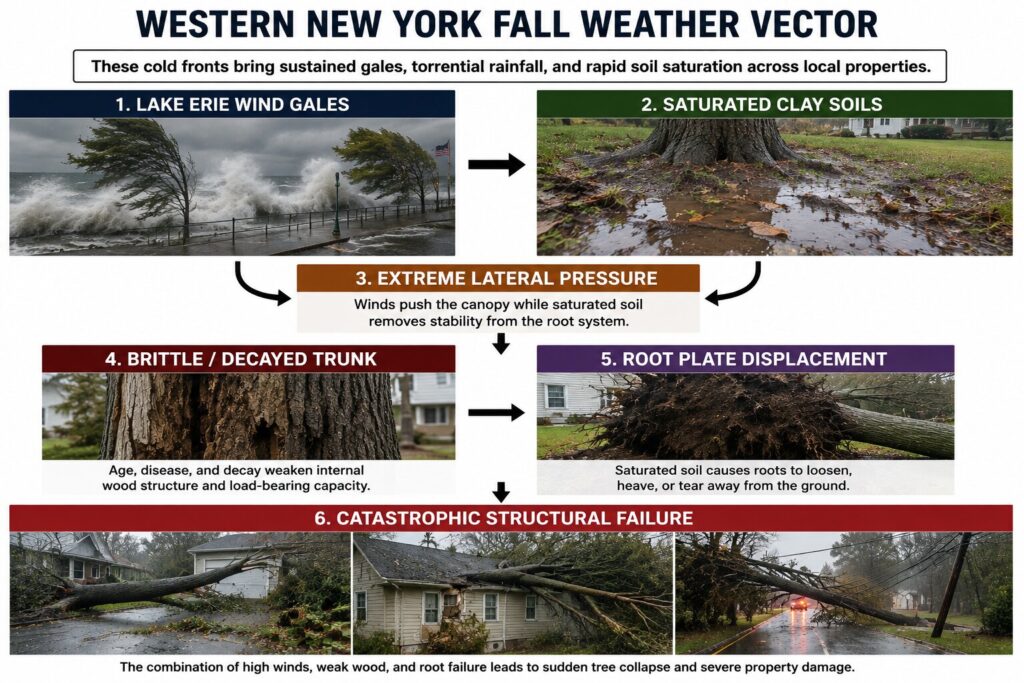
In heavy Lackawanna silt loam and urban clay soils, excessive moisture dramatically weakens root plate anchorage.
When anchoring root systems lose mechanical friction in saturated soil, structurally compromised trees become highly vulnerable to sudden uprooting.
Additionally, early lake effect storms can dump wet, heavy snow while deciduous trees still hold a full canopy of leaves.
This lingering leaf canopy acts like a sail, catching massive snow loads that add thousands of pounds of downward dynamic pressure.
Addressing dangerous tree warning signs in late summer or early fall prevents unexpected winter property damage and dangerous emergency situations.
Quick Decision Matrix: Tree Removal vs. Pruning vs. Cabling
Determining whether a hazardous tree Removal Buffalo requires full removal or targeted mitigation depends on several key structural variables.
Arborists assess the extent of internal decay, overall structural integrity, and target proximity before recommending a definitive course of action.
| Physical Tree Indicator | Risk Level | Primary Recommended Action | Applicable Industry Standard |
| Active Trunk Splitting | Immediate Emergency | Full Sectional Tree Removal | ANSI A300 Dismantling |
| Canopy Defoliation (>50%) | Critical Hazard | Complete Dead Tree Removal | ISA Level 2 Risk Assessment |
| Root Plate Heaving / Sudden Lean | Immediate Emergency | Crane Assisted Tree Removal | Emergency Rigging Safety |
| Co-Dominant Stem Separation | Severe Hazard | Structural Reduction or Removal | ANSI A300 Pruning / Cabling |
| Isolated Dead Branches (<3 in.) | Low to Moderate | Crown Maintenance / Deadwooding | ANSI A300 Pruning Standards |
| Emerald Ash Borer Infestation | High to Critical | Removal (if >30% canopy dead) | NYSDEC Quarantine Guidelines |
| Fungal Conks at Trunk Base | High Hazard | Advanced Internal Decay Testing | Sonic Tomography / Resistograph |
| Included Bark at Branch Junction | Moderate to High | Flexible Cabling & Static Bracing | ANSI A300 Part 3 (Cabling) |
| Trunk Hollow Cavity (>30%) | High Hazard | Full Removal or Monitoring | ISA Structural Evaluation |
| Recent Lightning Strike / Tear | Variable Hazard | Visual Tree Assessment (VTA) | Arborist Diagnostic Protocols |
Sign 1: Advanced Emerald Ash Borer (EAB) & Canopy Death
The Emerald Ash Borer (Agrilus planipennis) has devastated the native ash tree (Fraxinus) population across Western New York over the past decade.
This invasive wood-boring beetle destroys the tree’s vascular system located directly beneath the outer bark layer.
Larvae feed voraciously on phloem and xylem tissues, blocking nutrient and water transport between the root system and the canopy.
When an ash tree loses more than 30% of its upper canopy foliage, vascular transport failure is typically irreversible.
Key Dead Tree Symptoms of EAB Infestation:
- D-Shaped Exit Holes: Distinct 1/8-inch exit holes left in the outer bark by emerging adult beetles.
- Serpentine Larval Galleries: S-shaped, frass-filled tunnels clearly visible beneath peeling or split bark.
- Epicormic Sprouting: Dense clusters of fresh leafy shoots growing unnaturally out of the lower trunk base.
- Woodpecker Blondeing: Light-colored patches on the trunk created by native woodpeckers stripping bark to feed on larvae.
Dead ash wood loses moisture rapidly, turning structural limbs extremely brittle within a single season.
Unlike healthy hardwoods that flex naturally under wind loads, dead ash trees can shatter unexpectedly under light tension.
Prompt dead tree removal Buffalo NY prevents hazardous ash trees from collapsing onto nearby structures during sudden fall windstorms.
Sign 2: Sudden Lean and Root Plate Shear in Heavy Clay Soil
Not all leaning trees require immediate removal.
Trees that grow at a natural angle over several decades often build secondary response wood to stabilize their weight distribution.
However, a sudden, acute, or worsening lean indicates active root plate shear below the ground level.
In Erie County communities like Hamburg, Orchard Park, East Aurora, and Clarence, clay-heavy soils retain excessive water during autumn rainstorms.
When heavy rain saturates the soil, the mechanical friction holding the root plate within the ground drops significantly.
Strong autumn winds create continuous lateral force, snapping anchoring root fibers that are under high mechanical tension.
Field Signs of Active Root Plate Failure:
- Soil Cracking and Mounding: Fresh, arc-shaped fissures or lifted soil mounds on the side opposite the direction of the lean.
- Exposed Broken Roots: Freshly snapped structural root ends protruding above the turf line near the root flare.
- Puddling Water in Fissures: Rainwater gathering inside open ground cracks around the root flare, accelerating fungal decay.
- Shifting Canopy Realignment: The tree canopy tilting noticeably closer to driveways, roofs, or utility lines after storm events.
When root plate shear occurs, complete uprooting can happen without warning during the next wind front.
Emergency tree removal using specialized crane equipment is often required to dismantle the tree safely without damaging adjacent property.
Sign 3: Deep Vertical Trunk Splits and Included Bark
Trees with multiple main trunks of similar size originating from a single junction are known as co-dominant stems.
These junctions frequently develop included bark, where bark becomes trapped deep within the narrow attachment crotch as the stems grow.
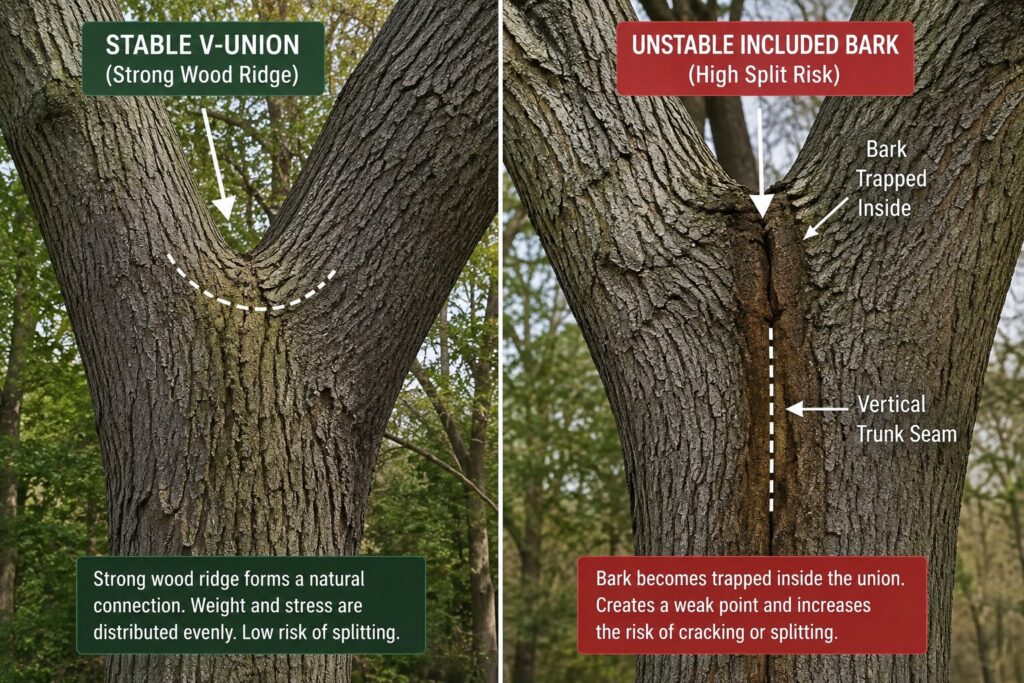
Included bark acts like a physical wedge embedded between expanding trunks.
As each stem grows in circumference annually, it pushes against the adjacent trunk instead of forming a continuous, solid wood bond.
Over time, this continuous expansion pressure creates deep vertical trunk splits that compromise the structural core of the tree.
Why Autumn Gales Cause Trunk Splitting:
During high wind events, co-dominant stems sway out of phase with each other.
This twisting motion creates intense mechanical pressure at the junction, widening hidden seams into major structural cracks.
Indicators of Structural Trunk Split:
- Deep vertical seams extending downward from the primary branch union into the main trunk cavity.
- Dark liquid, foam, or sap bleeding continuously from a central junction crack.
- Fungi or insect activity concentrating heavily along an open seam line.
- Fresh white wood exposed inside a widening trunk split after a major storm event.
Minor trunk cracks can sometimes be stabilized using flexible steel cabling and static bracing under ANSI A300 Part 3 standards.
However, deep splits that compromise primary load bearing wood generally require complete tree removal to ensure safety.
Sign 4: Internal Decay, Basal Hollows, and Fungal Conks
A mature tree can maintain a lush green canopy while its internal structural core is hollow or decaying rapidly.
Saprophytic fungi enter trunks through old pruning cuts, lawnmower strikes, or storm wounds, gradually digesting internal heartwood.
Heartwood provides essential mechanical rigidity, while outer sapwood transports water and nutrients.
As decay organisms break down lignin and cellulose, the tree loses its structural load-bearing strength.
Common Fungal Types and Structural Impacts:
- White Rot Fungi: Breaks down lignin, leaving remaining structural wood soft, spongy, and stringy.
- Brown Rot Fungi: Degrades cellulose, causing wood to check into dry, brittle, cubical fractures that crumble easily.
- Soft Rot Fungi: Creates microscopic cavities within cell walls, leading to a gradual, unseen loss of wood elasticity.
Field Warning Signs of Dangerous Tree Decay:
- Basal Fungal Conks: Bracket fungi like Ganoderma applanatum or Inonotus dryadeus growing near the root flare indicate root rot.
- Hollow Resonance: Tapping the trunk with a rubber mallet produces a hollow, drum-like ring rather than a solid thud.
- Large Cavities: Open hollows that exceed 30% to 35% of the total trunk diameter at ground level.
- Soft, Crumbling Wood: Spongy wood that can be easily pulled apart by hand inside an open cavity.
If a hazard safety assessment reveals significant internal wood loss, early tree removal is recommended before autumn gale winds hit.
Sign 5: Large Dead Branches & Canopy “Widowmakers”
Complete tree removal is not always required when structural damage is isolated to a single branch or canopy section.
However, large dead branches distributed throughout the upper canopy pose immediate safety risks to residents and property below.
Arborists refer to unattached or broken dead branches hanging overhead in the canopy as widowmakers.
These dry, brittle branches lack living cell elasticity and natural moisture content.
While they may remain suspended during quiet summer months, autumn weather conditions drastically increase the risk of sudden limb drop.
Rain, high wind gusts, and early wet snow add significant dynamic weight to dead branches, causing them to break free without warning.
High-Risk Deadwood Conditions:
- Branch Diameter Threshold: Dead limbs greater than 2 to 3 inches in diameter carry enough mass to breach rooflines, smash vehicles, or cause serious personal injury.
- Target Footprint Proximity: Dead limbs hanging directly over high-traffic zones like driveways, patios, walkways, or public sidewalks.
- Union Attachment Decay: Bark shedding and fungal growth visible at the branch shoulder, indicating the attachment point is failing.
When deadwood is localized, crown cleaning and hazard pruning by a certified arborist in Buffalo, NY can often resolve the issue.
If canopy mortality exceeds 50%, full tree removal is usually the safest long-term recommendation for property protection.
Western New York Tree Species Failure Profiles
Tree species common to Western New York exhibit distinct structural failure patterns under autumn weather stress:
- Ash (Fraxinus americana / Fraxinus nigra): EAB larval feeding causes rapid vascular failure and extreme wood brittleness. Upper canopy branches shatter under light wind loads, and trunks can snap cleanly at ground level without root plate rotation.
- Silver Maple (Acer saccharinum): Rapid growth results in soft wood structure prone to co-dominant splits and internal trunk hollows. Large limbs tear out under early heavy snow loads, and main trunk junctions split open during Lake Erie gale events.
- Norway Maple (Acer platanoides): Shallow root systems combined with high susceptibility to girdling roots, verticillium wilt, and trunk decay. Demonstrates complete tree uprooting in wet, rain-saturated clay soils during high-wind fronts.
- Bradford Pear (Pyrus calleryana): Poor branch architecture with multiple co-dominant stems and tight, included bark crotches. Major sections of the tree split apart in moderate storms, leaving jagged, unsalvageable stumps.
- Willow (Salix alba / Salix babylonica): Fast-growing, weak wood vulnerable to internal trunk rot, hollow cavities, and fungal disease. Prone to major limb failure and sudden trunk failure under saturated soil and wind conditions.
The Professional Hazard Tree Assessment Process
Evaluating whether a tree can be safely preserved or needs to be removed requires a professional hazard assessment.
An ISA Certified Arborist uses standardized diagnostic procedures to determine a tree’s health and failure probability:
- Target Evaluation: Assessing property, vehicles, utility drop lines, and high-foot-traffic areas within the fall zone footprint of the tree.
- Visual Tree Assessment (VTA): Systematically inspecting the root crown flare, trunk taper, structural unions, bark condition, and leaf canopy density.
- Advanced Diagnostic Testing: Using acoustic tomography to measure sound wave speeds across trunk tissue, mapping internal decay pockets non-invasively. Resistograph micro-drilling measures wood density variations to confirm structural shell thickness.
- Mitigation Protocol: Developing an actionable plan compliant with ANSI A300 standards, detailing whether pruning, cabling, or crane removal is required.
Legal, Insurance, and Municipal Regulations in Erie County
Understanding tree ownership liabilities, local insurance rules, and municipal codes is essential when managing private or municipal trees across Western New York.
New York State Common Law on Tree Liability
Under New York State common law, property owners have a legal responsibility to inspect and maintain trees on their land.
If a dead, decayed, or dangerous tree falls onto a neighbor’s property, the tree owner can be held legally liable for all resulting damage if prior knowledge of the hazard existed.
- Constructive Notice: If a tree displays visible signs of decay or structural failure for a prolonged period, courts may determine that the owner had “constructive notice” of the hazard.
- Insurance Claim Coverage: Homeowners insurance generally covers sudden storm damage caused by healthy trees (“Acts of God”). However, if an insurance adjuster finds the fall resulted from unaddressed pre-existing decay, coverage claims may be denied.
Local Municipal Ordinances
Within the City of Buffalo, street trees located in the public right-of-way (between the sidewalk and street curb) fall under the control of the City Forester and Department of Public Works.
Property owners must obtain municipal authorization before pruning or removing trees on public property.
In suburban municipalities like Amherst, Cheektowaga, Tonawanda, Kenmore, Williamsville, and Lackawanna, private trees are managed directly by property owners. However, trees bordering public parks, utility corridors, or wetlands may require local permits prior to removal.
Frequently Asked Questions
How do I know if a tree needs to come down?
A tree usually needs to come down if more than 50% of its canopy is dead, its primary trunk has split open, its root plate is lifting from the soil, or it exhibits severe internal decay near the base. A visual inspection by an ISA Certified Arborist provides an accurate determination.
Is a leaning tree dangerous?
A leaning tree is dangerous if the lean developed suddenly after a storm, if the soil is cracking or mounding around the root base, or if roots are broken. Trees that have grown at a gradual, stable angle over many years are generally less hazardous unless internal rot is present.
What are the signs of a dead tree?
Common dead tree symptoms include complete lack of leaves during the growing season, brittle branches that break easily, peeling bark, fungus growing around the root flare, a hollow trunk, and extensive woodpecker damage.
Should I remove a tree before fall?
Yes. Removing a hazardous tree before fall in Buffalo, NY reduces the risk of branch failure or uprooting during high wind events, autumn heavy rain, and early lake-effect snowstorms.
How much does tree removal cost in Buffalo NY?
Tree removal costs in Buffalo, NY generally range from $450 to $2,500+ depending on tree height, location complexity, proximity to structures or power lines, requirement of crane equipment, and crew size. Emergency tree removals or hazardous tree removals near power lines typically fall at the higher end of the scale.
Can a diseased tree be saved?
Some diseased trees can be saved if the disease is diagnosed early and treated with targeted pruning, soil micro-injections, or fungicide applications. However, if fungal decay has compromised the structural integrity of the trunk or roots, removal is necessary.
What happens if I leave a dead tree standing?
Leaving a dead tree standing increases the risk of unpredictable collapse, property damage, personal injury, and financial liability. As structural wood decays over time, removal becomes more dangerous and expensive.
When is the best time to remove a tree?
Late summer and early fall are optimal times for hazard tree removal in Western New York before severe weather develops. Late winter is also a good time for routine removals while the ground is frozen and trees are dormant.
Fall Property Safety Checklist
Before autumn storms and winter weather arrive in Western New York, inspect your trees using this homeowner checklist:
- [ ] Base Inspection: Check the trunk base and root flare for fungal conks, mushrooms, or open hollows.
- [ ] Soil Line Examination: Look for cracked, raised, or mounded soil near leaning trees after heavy rainfall.
- [ ] Trunk Junction Check: Inspect multi-trunk unions for vertical split cracks, bleeding sap, or trapped bark.
- [ ] Canopy Review: Identify large dead limbs (greater than 2 inches in diameter), bare branch tips, or broken hanging branches.
- [ ] Target Zone Mapping: Note any hazardous trees standing within falling distance of houses, driveways, garages, or power lines.
Recognizing early warning signs such as EAB infestation, sudden leans, trunk splits, internal decay, or heavy canopy deadwood allows you to take action before seasonal weather arrives.
Scheduling a professional inspection with a certified arborist in Buffalo NY ensures your trees are properly evaluated, protecting your property, family, and landscape through the fall and winter seasons.