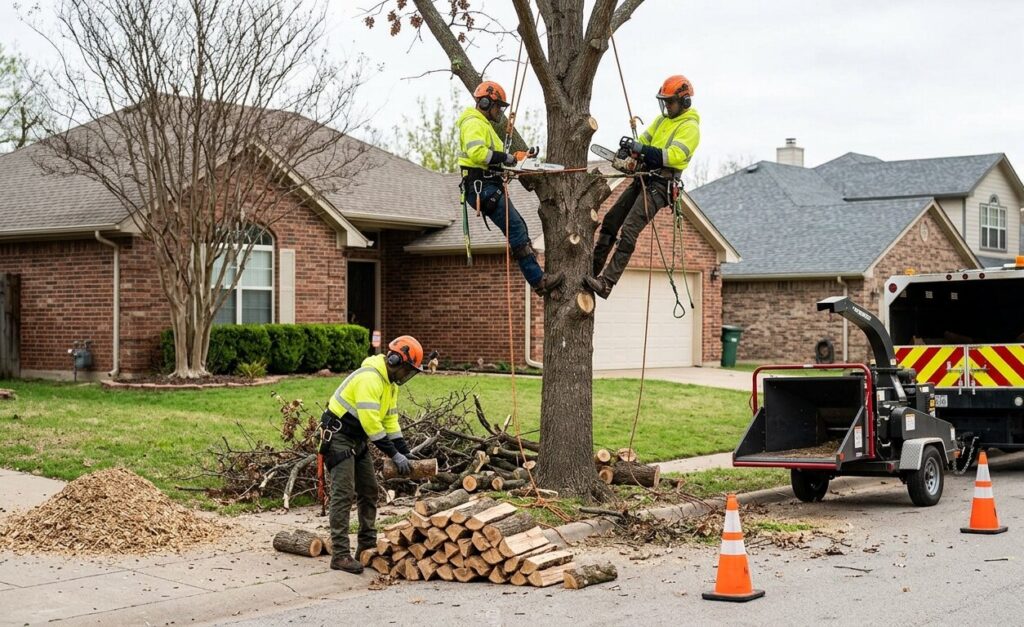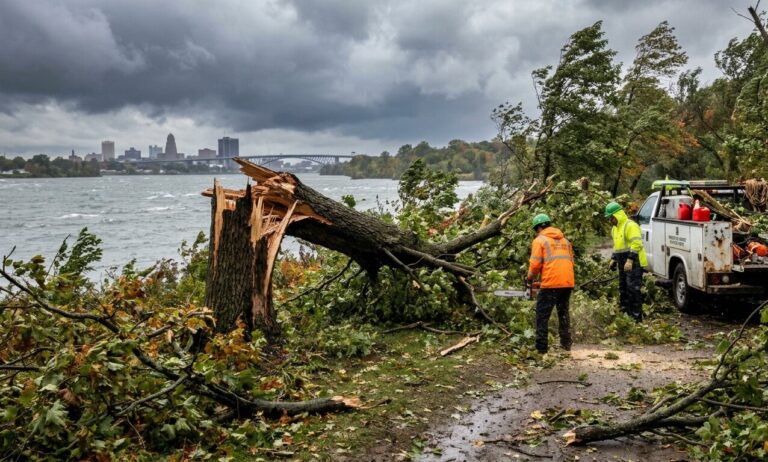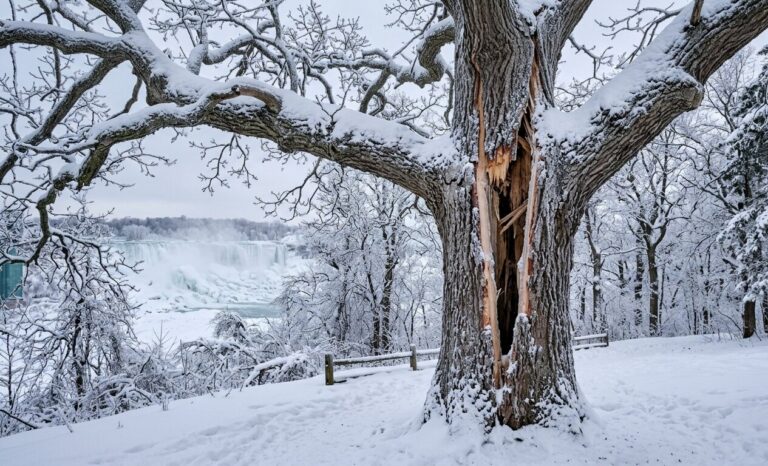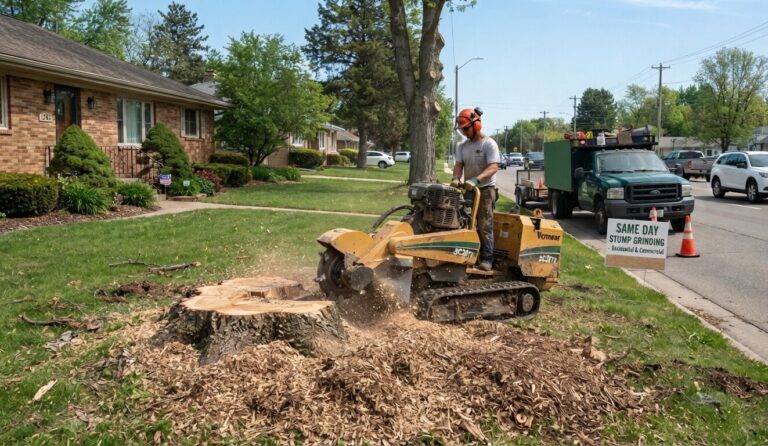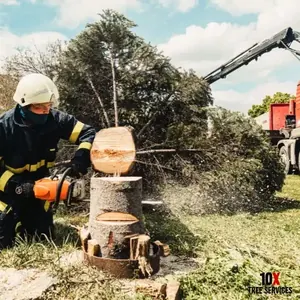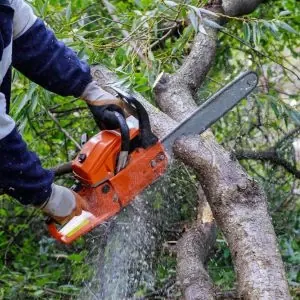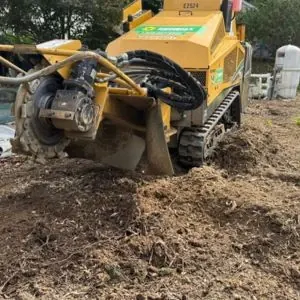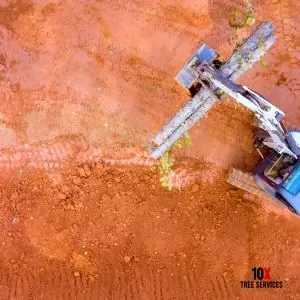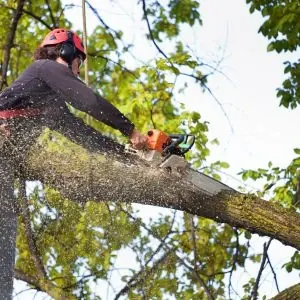
The best way to save money on tree removal is to compare itemized estimates, schedule non emergency work strategically, bundle multiple trees, clarify stump and debris costs, and choose the appropriate removal method. In Buffalo NY, tree size, condition, access, structures, utility lines, equipment, cleanup, and urgency can significantly affect the final price.
How to Save Money on Tree Removal Without Cutting Corners
Tree removal can become expensive when homeowners wait until a tree becomes an emergency or compare contractors based only on the lowest advertised price.
The smarter approach is to control the avoidable costs while keeping the actual removal safe and properly planned.
Tree height, trunk diameter, condition, accessibility, proximity to structures, power lines, equipment requirements, and cleanup can all affect the price. Current 2026 consumer cost data also shows that professional tree-removal pricing varies substantially from project to project rather than following one universal rate.
For Buffalo homeowners, this matters because a mature tree in an open yard is a completely different project from a tree positioned between a house, garage, fence, driveway, sidewalk, or utility line.
The goal should therefore be affordable tree service, not simply the cheapest possible quote.
10 Ways to Save Money on Tree Removal
| Money-Saving Strategy | Potential Cost Benefit | What to Ask |
|---|---|---|
| Compare multiple estimates | Helps identify unrealistic or incomplete pricing | Is the quote itemized? |
| Schedule non-emergency work in advance | Gives you more scheduling flexibility | Is there seasonal availability? |
| Remove multiple trees together | May reduce repeated mobilization | Can you price the trees as one project? |
| Clarify debris disposal | Prevents unexpected hauling charges | Is all cleanup included? |
| Compare stump options | Avoids paying for unnecessary excavation | Is grinding sufficient? |
| Keep usable wood | May reduce hauling requirements | Can I keep selected logs? |
| Improve equipment access | Can reduce manual handling | What needs to be moved before arrival? |
| Address problems early | Avoids potentially more complex emergency work | Does this tree need removal now? |
| Ask about the removal method | Helps prevent unnecessary equipment costs | Will rigging, a lift, or crane be required? |
| Compare total scope not just price | Prevents false “cheap” quotes | What exactly is included? |
1. Get Multiple Tree Removal Estimates
Getting more than one estimate is one of the simplest ways to determine whether a quote is competitive.
But do not compare only the final number.
Compare the scope of work behind the number.
For example, one contractor may include:
- Tree removal
- Limb removal
- Brush cleanup
- Log hauling
- Chipping
- Stump grinding
Another quote may include only the tree removal itself.
The second quote may initially appear cheaper but become more expensive after additional services are added.
Penn State Extension recommends obtaining written estimates, asking for proof of insurance, getting multiple bids, and clearly defining cleanup, firewood ownership, stump grinding, and total cost in the contract.
What to compare between estimates
Ask each tree service:
- What exactly is being removed?
- Is cleanup included?
- Is brush chipped?
- Are logs hauled away?
- Is stump grinding included?
- Are disposal fees included?
- Is specialized equipment included?
- Could additional charges apply?
- What insurance coverage does the company carry?
- What is the total project price?
That gives you an apples-to-apples comparison.
2. Ask for an Itemized Quote
An itemized estimate makes it much easier to understand where your money is going.
A professional estimate should distinguish between the primary removal and optional or additional services when appropriate.
A typical project might involve:
Tree removal → cutting and lowering → processing → cleanup → hauling → stump work
Each stage can affect the total project cost.
If the quote simply says “tree removal — $X”, ask what that number includes.
This is particularly important when comparing cheap tree removal offers.
A cheap headline price does not necessarily mean a cheap completed project.
3. Understand What Actually Determines Tree Removal Cost
There is no single average cost to remove a tree that accurately applies to every property.
Current 2026 cost data commonly places ordinary professional tree removal in the hundreds to low thousands of dollars, but large, hazardous, or difficult-access trees can cost considerably more. One current national cost guide reports an average around $750 and a broad range of approximately $200 to $2,000+, with substantially higher prices possible for unusually difficult trees.
Treat national averages as budgeting references not Buffalo-specific quotes.
The biggest cost factors are usually:
Tree size
A taller tree generally requires more labor, more time, and potentially specialized equipment.
Trunk diameter
Large trunks create more wood to cut, process, move, and potentially haul away.
Tree condition
Dead, decayed, split, storm-damaged, or structurally compromised trees may require additional precautions.
Location
A tree standing close to a house, garage, fence, road, or other target can require more controlled removal.
Accessibility
A tree that equipment can easily reach may be less complicated than one located behind a narrow gate or in a restricted backyard.
Utility lines
Trees near electrical infrastructure introduce additional safety considerations and can substantially change the removal approach.
Cleanup
Branches, logs, chips, and other debris can affect the final scope.
Stump work
Stump grinding or complete stump removal may be priced separately.
Urgency
An emergency tree removal can require rapid mobilization and different equipment or scheduling.
These factors are consistent with current cost guidance identifying size, location, accessibility, structures, utilities, equipment, and cleanup as important pricing variables.
4. Schedule Planned Tree Removal Before It Becomes an Emergency
One of the best ways to control costs is to deal with a tree before the situation becomes urgent.
A tree with significant deadwood, structural defects, severe decline, or storm damage may become more difficult to manage after another weather event.
Planning ahead gives you time to:
- Compare estimates
- Schedule the crew
- Prepare the property
- Move vehicles
- Discuss wood disposal
- Compare stump options
- Confirm cleanup
- Understand the removal method
Emergency work is different.
When a tree has already fallen across a driveway, damaged a roof, blocked access, or created an immediate hazard, the homeowner has fewer opportunities to shop around.
The ISA’s TreesAreGood guidance emphasizes that tree-risk conditions should be evaluated appropriately and that corrective options can include pruning, support systems, or removal depending on the circumstances.
5. Consider Off-Season Tree Work When It Is Safe
You may hear that off season tree trimming or winter tree removal is automatically cheaper.
That is too broad.
Pricing depends on the local company, workload, tree condition, accessibility, equipment, and type of project.
However, scheduling non-emergency work in a less busy period can sometimes give homeowners more flexibility.
The important distinction is:
Planned work can be scheduled strategically.
Hazardous work should not be delayed simply to chase a seasonal discount.
If a tree is unstable or presents an immediate risk to people or property, safety takes priority over timing.
6. Remove Multiple Trees as One Project
If you have several trees that need attention, ask whether completing them together can reduce overall project costs.
A tree service may otherwise need to repeat:
- Travel
- Crew mobilization
- Equipment setup
- Site preparation
- Cleanup
- Hauling
Combining several appropriate jobs can potentially improve efficiency.
For example, if two or three declining trees are located in the same part of your property, ask for:
Individual pricing
and
Bundled project pricing
You can then compare the total.
This strategy can also apply to neighboring homeowners who have multiple properties requiring work. Penn State Extension specifically notes that homeowners can sometimes combine nearby work to create a larger job for bidding tree services.
7. Ask Whether You Can Keep Some of the Wood
Large tree removals can produce a significant amount of usable wood.
If you have appropriate space, ask whether you can keep selected logs for:
- Firewood
- Fire-pit use
- Landscaping
- Woodworking
- Other household purposes
Reducing the amount of material that needs to be hauled away may affect the project scope.
But do not assume that keeping the wood automatically makes the job cheaper.
Ask the tree service:
“If I keep the larger logs, does that change the removal or hauling price?”
That gives you a concrete answer instead of guessing.
8. Understand Tree Debris Disposal Fees
Tree debris disposal fees can become an overlooked part of the total cost.
After removal, you may have:
- Branches
- Brush
- Logs
- Leaves
- Wood chips
- Sawdust
Current 2026 cost guidance indicates that debris-removal expenses can vary with load size, disposal distance, access, and the number of trips required.
So ask exactly what happens to the material.
Possible arrangements
Full haul-away
The company removes and disposes of the material.
Chipping
Branches are processed into chips, which may be removed or left onsite depending on the agreement.
Firewood/log retention
Selected logs remain on the property.
Partial cleanup
Certain material remains for the homeowner to handle.
The cheapest option depends on your property and how much cleanup you are willing to manage.
9. Compare Stump Removal vs. Stump Grinding
Removing the tree does not necessarily mean the stump must be completely excavated.
This is where understanding stump removal vs stump grinding can save money.
Stump grinding
A grinder reduces the remaining stump to below or near ground level.
This can be practical when your objective is to:
- Remove the visible obstruction
- Make mowing easier
- Reclaim lawn space
- Reduce a trip hazard
- Prepare the surface for ordinary landscaping
Complete stump removal
Complete removal can involve excavating a larger portion of the stump and root system.
This may be more appropriate when the area will be used for:
- Construction
- A new structure
- A driveway
- Major hardscaping
- Certain landscape installations
Which is cheaper?
In many ordinary residential situations, grinding is the more economical option because it does not require the same degree of excavation.
But the right choice depends on what you intend to do with the area afterward.
Do not pay for complete stump excavation if grinding accomplishes your actual objective.
10. Make Sure “Cheap Tree Removal” Is Actually a Good Deal
Searching for cheap tree removal Buffalo NY is understandable.
Nobody wants to overpay.
But tree removal is one service where the lowest quote can create problems if the scope, insurance, safety procedures, or cleanup expectations are unclear.
A professional tree-removal project may involve:
- Chainsaws
- Ropes
- Rigging
- Chippers
- Bucket trucks
- Loaders
- Cranes
- Traffic or pedestrian considerations
- Property protection
Trees near buildings and utilities require especially careful planning.
The International Society of Arboriculture’s consumer guidance warns that trees associated with utility lines present serious hazards and says homeowners should never attempt to remove branches or tree parts from or near power lines.
So the right question is not:
“Who is cheapest?”
It is:
“Who provides the safest complete scope at a fair total price?”
What About Free Tree Removal Near Power Lines?
The search phrase free tree removal power lines can be confusing.
A tree involving electrical infrastructure is not an ordinary homeowner tree-removal project.
Never cut or climb a tree that is contacting or threatening electrical lines yourself.
TreesAreGood specifically warns that trees interacting with utility lines can cause injury, property damage, outages, fires, and other hazards.
If a tree or branch is contacting a power line, contact the appropriate electric utility and keep people away from the area.
Never treat utility-line tree work as a DIY cost-saving opportunity.
Can a Tree Removal Cost Calculator Tell You the Real Price?
A tree removal cost calculator can help you establish a rough planning budget.
It cannot provide the same information as an actual site evaluation.
A calculator may ask for:
- Tree height
- Trunk diameter
- Tree type
- Location
- Accessibility
- Number of trees
- Stump requirements
But it cannot fully understand the physical relationship between the tree and your property.
Consider two 60-foot trees.
Tree A
Located in an open backyard with clear equipment access.
Tree B
Located between a house, garage, fence, driveway, and utility infrastructure.
Both are approximately 60 feet tall.
They are not necessarily comparable removal projects.
That is why online calculators should be treated as budgeting tools rather than guaranteed quotes.
What Is the Average Cost to Remove a Tree?
The average cost to remove a tree is useful only as a broad planning reference.
Current 2026 national data from Angi reports an average around $750, while also showing a broad range depending on tree size, location, accessibility, and other project factors.
The same source reports that larger trees and trees near structures or utility lines can require substantially more labor and equipment.
Therefore, a homeowner should not use a national average as a promised Buffalo price.
Better budgeting questions
Instead of asking:
“What is the average price of tree removal?”
Ask:
“What factors make this specific tree more or less expensive to remove?”
That question produces a much more useful estimate.
How Buffalo NY Property Conditions Can Affect Tree Removal Cost
Buffalo and Western New York contain a wide variety of residential property layouts.
A tree in North Buffalo may have different access conditions from one in a larger suburban yard in Amherst.
A mature tree in Elmwood Village or Parkside may be surrounded by structures, sidewalks, driveways, fences, and neighboring properties.
Properties in Allentown, South Buffalo, Black Rock, Riverside, University Heights, the Delaware District, Lovejoy, and Kaisertown can also present different access and target conditions.
Nearby Western New York communities such as:
- Amherst
- Cheektowaga
- Tonawanda
- West Seneca
- Lackawanna
can have different lot sizes, setbacks, access points, and surrounding infrastructure.
This is why local tree removal pricing cannot be reduced to a single citywide number.
The relevant relationship is:
Buffalo NY → residential property → mature tree → tree condition → access → nearby targets → removal method → equipment → cleanup → final project scope.
That is the context homeowners should use when evaluating an estimate.
How to Find an Affordable Tree Service in Buffalo NY
If you are searching for an affordable tree service in Buffalo NY, look for a provider that gives you a clear scope and written pricing.
Before accepting an estimate, ask:
1. Is the company insured?
Ask for appropriate proof of insurance.
2. Is the estimate written?
Verbal pricing can make it difficult to determine what was actually agreed upon.
3. Is cleanup included?
Clarify branches, brush, logs, chips, and general cleanup.
4. Is stump grinding included?
Do not assume it is included unless the estimate says so.
5. What happens to the wood?
Determine whether it is hauled away, chipped, cut into logs, or left onsite.
6. Could specialized equipment be required?
Ask whether a lift, crane, rigging system, or other equipment is anticipated.
7. Are there potential additional charges?
Get these explained before work begins.
Penn State Extension similarly recommends written estimates, proof of insurance, multiple bids, local references, and a detailed contract covering cleanup, firewood ownership, stump grinding, and total cost.
What Does an Arborist Cost Per Hour?
The search phrase arborist cost per hour can be misleading because professional tree work is not always priced strictly by the hour.
Some projects may be quoted as:
- Flat-rate tree removal
- Per-tree pricing
- Project pricing
- Hourly labor
- Equipment plus labor
- Inspection or consultation pricing
Current 2026 consumer data shows that arborist costs vary widely by service, tree size, location, and project complexity.
For homeowners, the better question is usually:
“What is the total price for the complete scope of work?”
A lower hourly rate does not necessarily produce a lower final bill if the project takes longer.
Should You Trim a Tree Instead of Removing It?
Sometimes.
Tree removal is not automatically the answer to every tree problem.
Depending on the tree and the identified risk, professional tree care may include:
- Selective pruning
- Deadwood removal
- Structural pruning
- Crown management
- Cabling or bracing where appropriate
- Monitoring
- Complete removal
ISA guidance notes that risk management can include pruning, support systems, routine care, or removing a tree when appropriate.
The important point is to determine why the tree is being removed.
If the concern can safely be addressed through appropriate tree care, removal may not be necessary.
If the tree has an unacceptable risk that cannot reasonably be mitigated, postponing removal simply to save money may create greater costs later.
How 10X Tree Services Can Help Buffalo Homeowners
For homeowners looking for professional tree service in Buffalo and Western New York, 10X Tree Services provides residential and local tree-care services.
The company offers services including:
- Tree Removal Buffalo NY
- Tree Trimming Buffalo NY
- Stump Grinding
- Stump Removal
- Fallen Tree Removal
- Crane Tree Removal
- Emergency Tree Service
- Storm-Damage Cleanup
- Tree Care & Maintenance
- Land Clearing
10X Tree Services focuses on Greater Buffalo and surrounding Western New York communities.
You can visit 10X Tree Services to review services and request information about your project.
For an estimate, homeowners can make the process easier by identifying:
- Approximate tree location
- Number of trees
- Nearby structures
- Access limitations
- Utility-line concerns
- Whether stump grinding is wanted
- Whether wood should be removed
- Desired cleanup level
That information helps establish a clearer project scope.
A Buffalo Homeowner’s Tree Removal Cost-Saving Checklist
Before approving the work, use this checklist:
Before getting estimates
- Determine whether removal is actually necessary.
- Identify how many trees need attention.
- Photograph the tree and surrounding area.
- Note nearby structures and utility lines.
- Consider whether stump grinding is necessary.
- Decide whether you want wood removed.
When comparing estimates
- Get multiple written estimates.
- Compare the complete scope.
- Verify insurance.
- Confirm cleanup.
- Confirm debris disposal.
- Confirm stump services.
- Ask about equipment.
- Ask about possible additional charges.
Before work begins
- Move vehicles from the work area.
- Clear movable obstacles.
- Confirm the work scope.
- Confirm the final price.
- Confirm what happens to the wood.
- Confirm the cleanup expectations.
Frequently Asked Questions
How can I save money on tree removal?
The most effective strategies are comparing multiple written estimates, scheduling planned work in advance, combining multiple trees, clarifying debris and stump costs, improving site access, and choosing only the services you actually need.
What is the cheapest way to remove a tree?
There is no single cheapest method for every tree. The lowest-cost safe option depends on the tree’s size, condition, location, access, surrounding targets, removal method, and cleanup requirements.
Is cheap tree removal worth it?
Not automatically. Compare the complete scope, insurance, equipment, cleanup, stump work, disposal, and total price instead of selecting the lowest advertised number.
What is the average cost to remove a tree?
Current 2026 national cost data reports an average around $750, but actual prices vary considerably. Large trees, difficult access, structures, utility lines, specialized equipment, and cleanup can substantially change the final cost.
Is stump grinding cheaper than stump removal?
Stump grinding is often the more economical choice when the homeowner simply wants the visible stump reduced and the area reclaimed. Complete stump removal can make more sense when construction or major landscaping requires more extensive excavation.
Is winter the cheapest time for tree removal?
Not necessarily. Off-season scheduling can sometimes improve availability or pricing, but there is no universal winter discount. The tree’s condition, company workload, equipment requirements, and project complexity still determine the price.
Can a tree removal cost calculator give me an exact price?
No. A calculator can provide a rough budgeting estimate, but it cannot fully evaluate site access, structural defects, nearby targets, utility lines, removal techniques, or equipment requirements.
How much does an arborist cost per hour?
There is no universal hourly rate. Arborists and tree-service companies may use hourly, flat-rate, per-tree, inspection, equipment, or project-based pricing depending on the work. The total project scope is generally more useful than comparing hourly rates alone.
Can I get free tree removal if a tree is near power lines?
Do not assume so. Utility-line situations vary, and homeowners should never attempt to remove tree parts near electrical conductors themselves. Contact the relevant utility when a tree is contacting or threatening power infrastructure.
Should I remove several trees at once?
If multiple trees already need professional attention, ask for bundled pricing. Combining work may reduce repeated mobilization, setup, hauling, and cleanup, although the actual savings depend on the project.
How do I find an affordable tree service in Buffalo NY?
Get multiple written estimates from qualified local providers and compare the complete scope rather than just the advertised price. Confirm insurance, removal method, cleanup, disposal, stump work, equipment, and potential additional charges.
How do I find a tree cutting service near me?
Look for an established local tree-service provider, verify appropriate insurance, request a written estimate, and compare the complete project scope. Proximity is useful, but safety, qualifications, scope, and total value are more important than distance alone.
Final Answer: How to Save Money on Tree Removal
The best way to save money on tree removal is to plan the project instead of simply searching for the lowest price.
Get multiple written estimates.
Compare the complete scope.
Ask about debris disposal.
Determine whether stump grinding is sufficient.
Consider combining multiple trees.
Ask whether keeping usable wood changes the price.
Improve site access where possible.
Schedule non-emergency work strategically.
Most importantly, address hazardous trees before they become emergency situations whenever it is safe and practical to do so.
For Buffalo homeowners, the final price will depend on the specific tree and property not simply the city name.
A small tree in an open yard can be straightforward.
A mature tree beside a house, garage, fence, driveway, sidewalk, or utility line can require substantially more planning, labor, and specialized equipment.
The smartest way to get affordable tree removal is to reduce unnecessary costs not necessary safety measures.
For professional tree removal and tree-care services in Buffalo and Western New York, homeowners can learn more about 10xtreeservices.com.