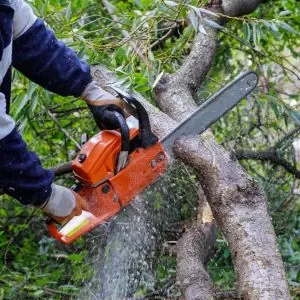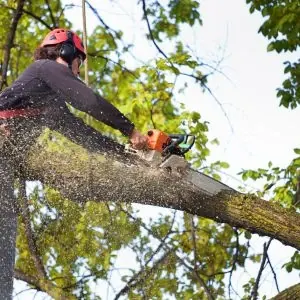
Tree care guide
What to Do Immediately When a Tree Branch Snaps and Hangs Over Your Driveway or Car
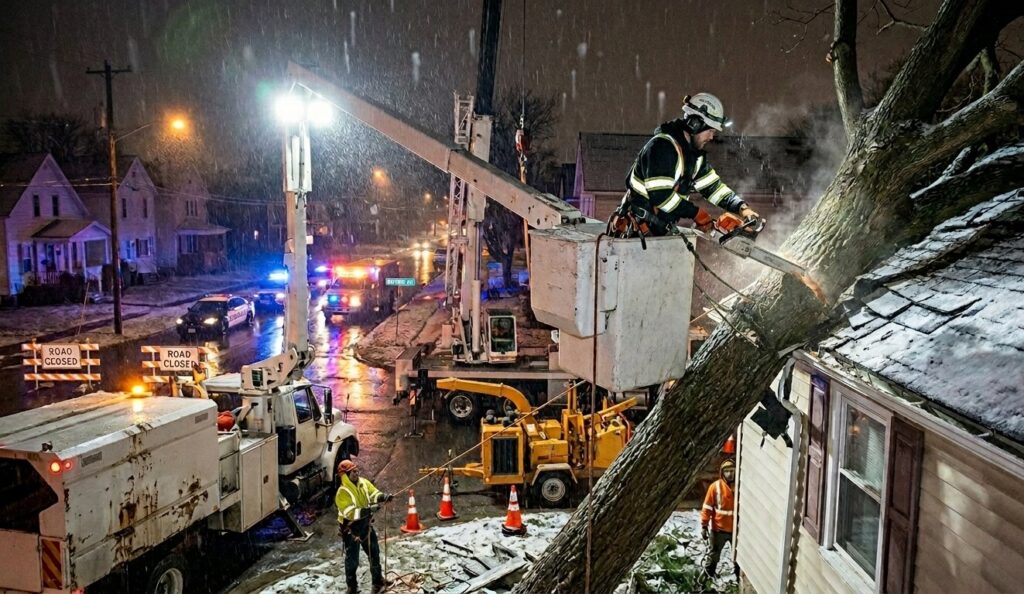
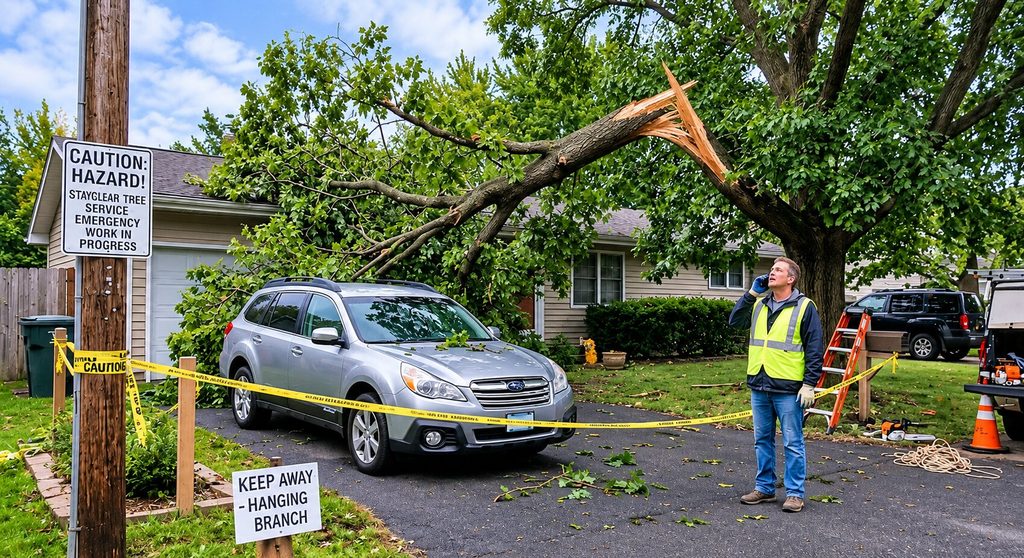
A snapped tree branch hanging over a driveway or car is a potential safety hazard because the damaged limb may fall without warning. Keep people and vehicles away, never pull or cut the branch yourself, check for power-line hazards from a safe distance, and arrange a professional tree assessment.
Why a Snapped Tree Branch Hanging Over Your Driveway Is Dangerous
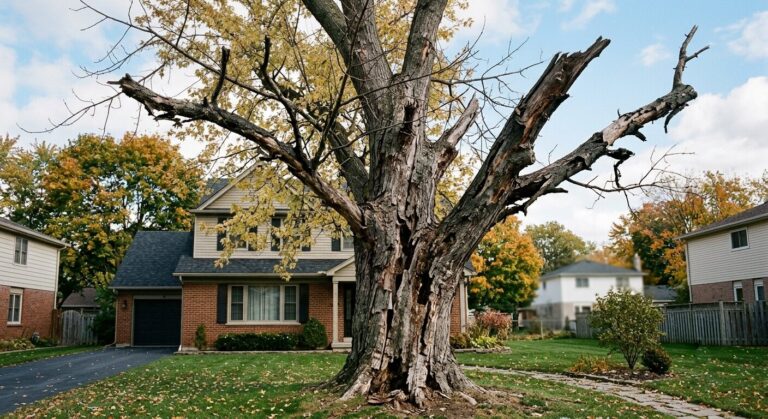
A broken branch does not have to fall to create an emergency. A partially attached limb can remain suspended in the tree, supported by other branches, lodged against the trunk, or caught above a vehicle or structure.
This type of damaged limb is sometimes called a hanger or hanging limb. Its position can change unexpectedly because of wind, gravity, rain, snow, ice, or movement in the remaining wood.
A hanging branch can:
- Fall onto a parked vehicle, damaging the roof, windshield, hood, or windows.
- Strike someone walking beneath the tree.
- Block a driveway and prevent vehicles from entering or leaving.
- Damage a garage, roof, fence, utility equipment, or nearby landscaping.
- Pull additional branches loose as the damaged section shifts.
- Create an electrical hazard if it contacts overhead wires.
Important: Do not stand underneath a broken branch to inspect how it is attached. A visual inspection from a distance is safer than approaching the tree.
The New York State Department of Environmental Conservation (NYSDEC) advises property owners to maintain a safe distance from damaged trees and hanging limbs after storms and to contact a qualified tree-care professional when individual trees need assessment.
What to Do Immediately When a Tree Branch Snaps and Hangs Over Your Car or Driveway
Your first priority should be protecting people, not moving the branch or saving the vehicle.
Follow these steps while waiting for the appropriate help.
1. Keep People, Children, and Pets Away
Immediately restrict access to the affected area.
Keep family members, visitors, delivery personnel, and pets away from the tree, driveway, and any area where the branch could fall. If possible, use another entrance or route that does not pass beneath the damaged limb.
Do not park another vehicle nearby.
A hanging branch can shift even when the weather appears calm. Avoid assuming that it is stable simply because it has remained in place for several minutes.
2. Do Not Cut, Pull, Push, or Climb to Remove the Branch
Never attempt to remove a large hanging limb with a ladder, pole saw, chainsaw, rope, or vehicle.
A damaged branch may contain significant stored tension. Cutting it in the wrong location can cause the limb to swing, split, rotate, or fall in an unpredictable direction.
Avoid these common mistakes:
- Pulling the branch with a rope or vehicle.
- Shaking the tree to dislodge the limb.
- Climbing onto the roof to reach the branch.
- Standing beneath the tree while using a ladder.
- Cutting through a partially broken limb without understanding its load and attachment.
- Asking an inexperienced person to remove it.
Professional tree workers assess the branch, surrounding tree structure, access, and potential targets before selecting a removal method.
3. Check for Electrical Hazards From a Safe Distance
This is one of the most important steps.
If the broken branch is touching, resting on, or close to an electrical wire, do not approach the tree. Never assume that a wire is harmless because it is not sparking, smoking, or making noise.
A tree branch can conduct electricity if it contacts an energized line.
If you see a downed power line or suspect that the branch is in contact with electrical equipment:
- Stay well away from the tree, wire, and anything touching them.
- Do not touch the branch, vehicle, fence, or other object that may be energized.
- Keep other people away.
- Contact 911 if a downed wire or immediate electrical danger is present.
- Notify the electric utility.
- Do not attempt tree removal until the utility has addressed the electrical hazard and the area is safe.
In New York, the Department of Public Service warns people not to move objects tangled in power lines and to treat fallen wires as dangerous.
A tree service should not be asked to handle an energized electrical line. Utility coordination and appropriately qualified line-clearance professionals may be necessary.
4. Keep Vehicles Out of the Drop Zone
If a snapped branch is hanging above your driveway, do not move a vehicle underneath it to get it out of the way.
If the car is parked outside the potential fall area and can be moved without entering the hazard zone, use your judgment. If moving it requires walking or driving beneath the damaged limb, leave it in place.
If a power line has fallen onto a vehicle, occupants should generally remain inside and wait for emergency responders. Do not touch the vehicle or attempt to exit unless remaining inside becomes immediately life-threatening, such as because of fire. Follow emergency responders’ instructions.
If someone is injured, trapped, or in immediate danger, call 911.
5. Document the Damage Only When It Is Safe
Photographs can help with a tree-service assessment and an insurance claim.
From a safe location, consider documenting:
- The broken branch and its position.
- The tree’s overall condition.
- Any visible damage to the vehicle, garage, roof, or driveway.
- The surrounding property.
- The approximate time and date of the incident.
Do not approach the tree to get a better photograph. Safety comes before documentation.
6. Contact a Professional Tree Service
Once people are away from the hazard and electrical concerns have been reported, contact a professional tree service for an assessment.
Explain whether the branch is:
- Hanging directly above a parked car.
- Suspended over a driveway or entrance.
- Resting on a garage, roof, or another structure.
- Partially attached to the trunk.
- Near overhead utility lines.
- Blocking access to your home or business.
Clear information helps the tree-service provider understand the situation and determine what assessment or equipment may be needed.
For urgent tree hazards in its service area, 10X Tree Services advertises a 24/7 emergency line at (716) 599-8733.
Quick Safety Checklist: What to Do and What to Avoid
| Situation | Recommended action | What to avoid |
|---|---|---|
| Branch hanging over a driveway | Restrict access and arrange an assessment | Walking or parking underneath it |
| Branch suspended above a car | Keep people away and document damage from a safe distance | Pulling the branch off the vehicle |
| Branch touching electrical wires | Stay away and contact 911/utility as appropriate | Touching the tree or attempting removal |
| Branch resting on a garage | Keep clear of the structure and call a professional | Climbing onto the roof |
| Large limb partially attached | Arrange professional removal | Cutting or shaking the limb |
| Someone injured or trapped | Call 911 | Attempting a dangerous rescue beneath the branch |
Why Do Tree Branches Suddenly Snap and Hang?
A tree branch can break because of weather stress, structural weaknesses, decay, or excessive weight. Sometimes the break occurs suddenly; in other cases, a branch has been weakening for months or years.
Western New York property owners should pay particular attention to several common causes.
1. Heavy Snow and Ice Accumulation
Snow and ice can add substantial weight to tree branches.
When the weight exceeds what a limb can support, it may bend, crack, split, or break. Some branches fall completely, while others remain attached and suspended in the canopy.
In Western New York, winter storms and lake-effect weather can create conditions that increase the risk of branch failure.
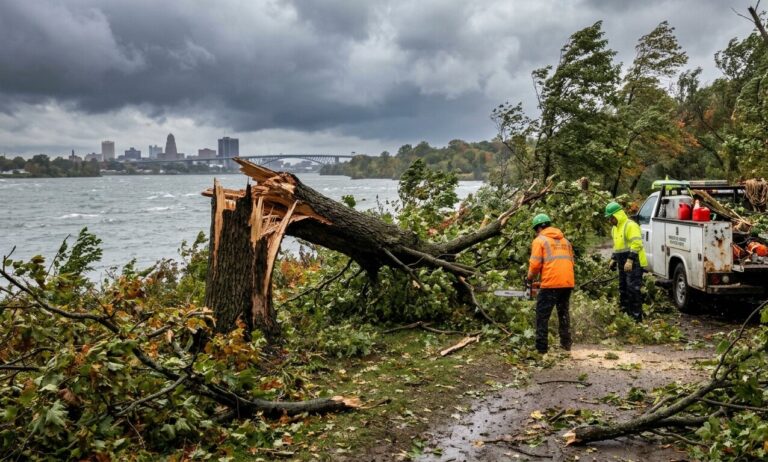
2. Strong Winds and Severe Storms
Strong wind places pressure on tree crowns and branches.
A branch with a weak attachment or existing crack may fail when the canopy moves during a storm. Wind can also cause multiple branches to collide, creating additional damage.
After severe weather, inspect trees from a safe location for broken limbs, leaning trunks, and hanging branches.
3. Deadwood and Internal Decay
Dead branches may become brittle and lose structural strength.
Decay can also weaken living or partially living branches, particularly when it affects an attachment point or major section of wood.
Warning signs may include:
- Large dead branches in the canopy.
- Cracks near branch unions.
- Cavities or visible decay.
- Fungal growth on the trunk or major limbs.
- Branches that have lost leaves prematurely.
These signs do not automatically mean the entire tree must be removed. A qualified assessment is needed to determine the extent of the damage.
4. Weak Branch Attachments and Included Bark
Some branches develop narrow or weak unions where two stems grow closely together.
Included bark can become trapped between the stems, preventing a strong wood connection from forming. Under wind or snow loading, these unions may be more vulnerable to splitting.
A professional tree assessment can help identify structural defects before they lead to branch failure.
5. Previous Storm Damage
A branch that survived an earlier storm may still have hidden cracks or weakened attachment points.
A later storm, heavy snowfall, or additional canopy movement can cause the damaged section to break.
That is why a tree should be assessed after significant storm damage, even if the first incident did not cause an obvious failure.
Warning Signs That a Tree Branch Could Break
Not every damaged branch is immediately dangerous, but certain warning signs deserve prompt attention.
| Warning sign | What it may indicate | Recommended response |
|---|---|---|
| Deep crack near a branch union | Structural weakness | Arrange a professional assessment |
| Large dead limb | Loss of branch strength | Have the limb evaluated |
| Branch hanging at an unusual angle | Partial failure or broken attachment | Keep the area clear |
| Split trunk or major stem | Serious structural damage | Keep away and seek urgent assessment |
| Freshly exposed broken wood | Recent branch failure | Check for additional hanging sections from a safe distance |
| Branch resting on another limb | Unstable support | Do not shake or pull it |
| Raised soil near the trunk | Possible root-plate movement | Keep away and contact a tree professional |
A tree with one broken branch may still be structurally sound. However, multiple broken limbs, a split trunk, or a newly leaning tree can indicate a more serious problem.
NYSDEC recommends looking for broken limbs, snagged or hanging branches, newly leaning trees, and raised soil around the trunk after storms.
What Happens During Professional Hanging Tree Limb Removal?
Removing a snapped branch over a driveway or car requires more than simply cutting through the damaged wood.
The appropriate approach depends on the branch’s size, height, attachment, condition, nearby structures, and access to the work area.
A professional assessment may involve the following steps.
Step 1: Inspect the Tree and Surrounding Area
The tree-care professional evaluates the damaged branch and identifies potential hazards.
This includes checking:
- The branch’s attachment point.
- Visible cracks and splits.
- The condition of nearby limbs.
- The tree’s overall structure.
- The location of vehicles and buildings.
- Overhead electrical equipment.
- Ground access and equipment placement.
The objective is to understand how the damaged limb may move during removal.
Step 2: Determine the Safest Removal Method
Not every hanging branch requires the same equipment or technique.
Depending on the situation, a professional may consider climbing and rigging, an aerial lift, or specialized equipment. Large or difficult removals may require additional planning.
A branch suspended above a car or garage requires particular attention to controlled movement and the protection of property beneath it.
Step 3: Secure and Remove the Damaged Limb
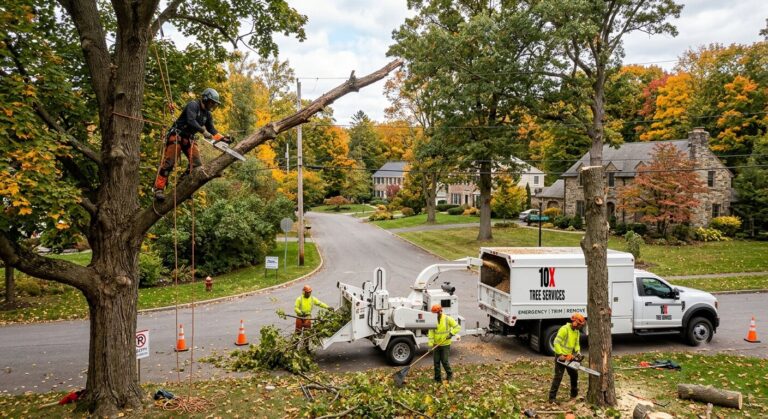
When appropriate, the crew uses professional equipment and controlled cutting techniques to manage the branch.
The removal plan should account for the limb’s weight, balance, attachment, and possible movement as it is cut.
The goal is to prevent uncontrolled falling and reduce the risk of additional damage.
Step 4: Inspect the Remaining Tree
After the damaged limb is removed, the remaining tree may need further inspection.
The professional may identify additional deadwood, cracks, weak unions, or storm damage that could create future problems.
Depending on the findings, the recommended work may involve selective pruning, additional hazardous-limb removal, or a separate tree-removal assessment.
Step 5: Clear the Debris and Restore Access
Once the work is complete, the crew can address the remaining branches and debris according to the agreed scope.
For a driveway emergency, restoring safe access is often a major priority.
Ask whether hauling, chipping, log removal, and cleanup are included in the estimate.
Does a Snapped Branch Mean the Entire Tree Needs to Be Removed?
No. A broken branch does not automatically mean the entire tree must be removed.
In many situations, the damaged limb can be removed while the rest of the tree remains.
The decision depends on the tree’s overall health, structural condition, location, and remaining defects.
| Tree condition | Possible recommendation |
|---|---|
| One damaged branch with otherwise sound structure | Selective branch removal |
| Several broken or dead branches | Professional pruning and risk assessment |
| Major split at a trunk or primary union | Detailed structural assessment |
| Extensive decay or severe structural damage | Evaluate whether removal is necessary |
| Significant root-plate movement or new leaning | Urgent professional assessment |
| Tree remains structurally sound after limb failure | Retain the tree with appropriate care |
A responsible tree-care recommendation should explain why a specific treatment is necessary.
Removing a healthy tree when selective pruning would address the hazard is not automatically the best solution. Equally, trimming a tree with serious structural damage may not adequately address the risk.
What If a Tree Branch Falls on Your Car?
A tree branch falling on a vehicle can cause anything from minor cosmetic damage to major structural damage.
The first priority is to make sure nobody is injured and that there is no electrical hazard.
What to Do After a Branch Hits Your Vehicle
- Check whether anyone is injured or trapped.
- Call 911 if there is an immediate emergency.
- Look for electrical wires from a safe location.
- Do not climb onto the vehicle or attempt to remove the branch.
- Photograph visible damage when it is safe.
- Contact your insurance company and ask about the claims process.
- Arrange professional tree removal if the branch remains unstable.
Potential vehicle damage includes:
- Broken windshields and windows.
- Dented roofs, hoods, and doors.
- Damaged mirrors and body panels.
- Scratched paint and trim.
- Damage to roof racks or other accessories.
- Possible damage to the vehicle’s structural components.
Do not drive a vehicle if the damage makes it unsafe to operate.
Does Homeowners Insurance or Auto Insurance Cover Tree Branch Damage?
Coverage depends on the circumstances, the insurance policy, the type of property damaged, and the cause of the incident.
If a tree branch falls on a parked car, the vehicle owner’s comprehensive auto coverage may apply, subject to the policy’s terms and deductible.
If a branch damages a house, garage, or another insured structure, homeowners insurance may provide coverage depending on the policy and the circumstances.
However, coverage is not automatic. Policy exclusions, maintenance issues, deductibles, and other conditions can affect a claim.
Before arranging major repairs, contact your insurer and ask:
- Which policy may apply?
- What photographs or documentation are needed?
- Should an adjuster inspect the damage?
- Is emergency mitigation or removal covered?
- Are there specific instructions for preserving damaged property?
Keep estimates, invoices, photographs, and communication records.
Important: This is general information, not an insurance coverage determination or legal advice. Your insurer and policy documents control the actual claim decision.
How Much Does Emergency Tree Branch Removal Cost?
There is no reliable single price for every hanging tree branch removal job.
A small broken limb in an open yard is very different from a large hardwood branch suspended above a vehicle, garage, or roof.
The cost of emergency tree branch removal depends on the work required and the hazards involved.
| Cost factor | Why it matters |
|---|---|
| Branch size and weight | Larger limbs may require more labor and specialized handling |
| Height and accessibility | Difficult-to-reach branches can require additional equipment |
| Vehicle or building location | Work above valuable property requires careful planning |
| Branch condition | Partially attached or split limbs may be more complicated |
| Electrical hazards | Utility coordination may be necessary before tree work |
| Equipment requirements | A lift, crane, or specialized rigging may affect the estimate |
| Emergency timing | Urgent scheduling and after-hours work may affect pricing |
| Cleanup and hauling | Debris removal and disposal can change the total scope |
How to Get an Accurate Tree Service Estimate
When requesting an estimate, provide the tree service with:
- Your property location.
- The approximate size of the broken branch.
- Whether the branch is above a car, garage, roof, or driveway.
- Whether the branch is still attached.
- Whether electrical wires are nearby.
- Photographs taken from a safe location.
Ask for a clear explanation of the proposed work, equipment, cleanup, and total price before non-emergency work begins.
Do not delay calling emergency services or the utility because you are comparing tree-service prices when an immediate life or electrical hazard exists.
Emergency Tree Branch Removal in Western New York
Western New York experiences a range of weather conditions that can place stress on residential and commercial trees.
Strong winds, heavy snowfall, ice accumulation, and severe storms can damage branches across the Niagara frontier and surrounding communities.
Property owners may encounter hanging limbs above:
- Residential driveways and garages.
- Commercial parking areas.
- Sidewalks and walkways.
- Fences and property entrances.
- Homes, sheds, and other structures.
- Vehicles parked beneath mature trees.
Areas Served by 10X Tree Services
10X Tree Services is based on Grand Island, NY, and lists service coverage across the Niagara frontier and nearby Western New York communities.
| Service area | Common property concerns |
|---|---|
| Grand Island, NY | Residential driveways, mature trees, and storm-damaged limbs |
| Tonawanda, NY | Overhanging branches near homes, garages, and driveways |
| Kenmore, NY | Mature residential trees and limited-access yards |
| North Tonawanda, NY | Broken limbs and storm-related tree damage |
| Niagara Falls, NY | Damaged trees near homes and commercial properties |
| Lewiston, NY | Large branches near structures and landscaped properties |
| Amherst, NY | Residential tree canopies and driveway clearance |
| Cheektowaga, NY | Storm-damaged branches and property access concerns |
| Wheatfield, NY | Large yard trees and wind-related branch damage |
| Sanborn, NY | Broken limbs and tree hazards after severe weather |
| Lockport, NY | Tree damage affecting driveways, buildings, and yards |
Service availability can depend on location, access, weather, and the urgency of the situation. Contact the company to confirm whether your property is within its current service area.
Why Contact 10X Tree Services for a Hanging or Broken Tree Branch?
When a branch breaks above a vehicle, driveway, or building, property owners need a clear assessment and an appropriate removal plan.
10X Tree Services provides tree removal, tree trimming and pruning, stump grinding, land clearing, and 24/7 emergency tree services from its Grand Island, New York base.
The company’s website identifies storm-damaged trees, branches over cars and driveways, and urgent tree hazards among the situations covered by its emergency service.
Tree Services That May Help
Emergency Tree Service
For urgent situations involving fallen trees, storm damage, and hazardous branches, 10X Tree Services advertises a 24/7 emergency line.
Learn more: 24/7 Emergency Tree Service
Tree Removal
If an assessment finds that a tree is severely damaged, structurally compromised, or unsuitable to retain, professional tree removal may be recommended.
Learn more: Tree Removal in Grand Island, NY
Tree Trimming and Pruning
When the remaining tree can be retained safely, selective pruning may help address damaged, dead, or hazardous branches.
Learn more: Tree Trimming and Pruning
What Property Owners Can Expect
According to its website, 10X Tree Services offers:
- A fully insured tree-service crew.
- Free estimates.
- A 24/7 emergency contact line.
- Tree removal and pruning services.
- Cleanup as part of its described work process.
- Service from its Grand Island base across listed Niagara frontier communities.
For a hanging branch above a driveway, car, or structure, explain the location and immediate hazard when calling.
Contact 10X Tree Services
- Phone: (716) 599-8733
- Email: sales@10xtreeservices.com
- Website: https://10xtreeservices.com/
- Base: Grand Island, NY
- Emergency availability: 24/7 line advertised by the company
If a power line is involved, contact 911 and the electric utility first. Do not approach the tree or attempt to move the branch.
How to Prevent Tree Branches From Falling Over Your Driveway
Not every branch failure can be predicted, but regular tree maintenance can help identify some problems before they become emergencies.
Schedule Periodic Tree Inspections
Have mature trees inspected when they show signs of structural weakness, decay, storm damage, or significant deadwood.
A professional can assess branch attachments, the canopy, and the overall tree condition.
Remove Hazardous Deadwood
Dead branches can become brittle and may fall during wind, snow, or ice events.
Appropriate pruning can remove selected dead or damaged limbs while preserving healthy parts of the tree.
Pay Attention to Weak Branch Unions
Narrow branch unions, included bark, and visible cracks can indicate structural weaknesses.
These areas deserve professional attention, especially when large limbs extend over driveways, garages, or frequently used spaces.
Keep Trees Clear of Structures
Branches growing over roofs, garages, parking spaces, and driveways should be assessed for clearance and structural condition.
Pruning should be based on the tree’s health and structure rather than simply cutting back every branch that extends over a property.
Inspect Trees After Severe Weather
After strong winds, heavy snow, or ice storms, look for visible damage from a safe location.
Watch for:
- Newly broken branches.
- Hanging limbs.
- Cracks in major branches.
- A newly leaning trunk.
- Soil lifting around the base.
- Branches resting on roofs or utility equipment.
Do not walk beneath a damaged canopy to inspect it closely.
Frequently Asked Questions About Snapped Tree Branches
1. What should I do if a tree branch snaps and hangs over my driveway?
Keep people and vehicles away from the area. Do not pull, cut, or shake the branch. Check for electrical hazards from a safe distance and contact a professional tree service for an assessment.
2. Is a hanging tree branch dangerous if it is still attached?
Yes. A partially attached branch can fall without warning, particularly if wind or additional weight causes it to move. Keep the area clear until it has been assessed and safely addressed.
3. Should I move my car if a broken branch is hanging above it?
Only move the car if you can do so without entering or passing through the potential fall zone. If a power line is on the vehicle, stay inside and wait for emergency responders unless remaining inside becomes immediately life-threatening.
4. Can I cut a snapped tree branch myself?
Small, accessible branches may be suitable for routine homeowner maintenance when there are no hazards. However, a large, suspended, cracked, or partially attached limb above a vehicle or structure should be handled by an appropriately equipped professional.
Never attempt DIY removal near electrical lines.
5. Who should I call for a tree branch hanging over my car?
If someone is injured, trapped, or in immediate danger, call 911. If electrical wires are involved, contact 911 and the utility. For a non-electrical tree hazard, contact a professional emergency tree service.
6. Does a snapped branch mean the tree must be removed?
No. A professional may determine that selective pruning is sufficient. Complete tree removal may be considered if the tree has serious structural damage, extensive decay, or other conditions that make retaining it unsafe.
7. Can a hanging branch fall without wind?
Yes. Gravity, weakened wood, a damaged attachment, or movement in supporting branches can cause a suspended limb to fall even when wind is light.
8. What causes tree branches to snap in Western New York?
Common causes include strong winds, heavy snow, ice accumulation, deadwood, decay, weak branch unions, and previous storm damage.
9. Does homeowners insurance cover a tree branch falling on a car?
Vehicle damage is generally considered under the vehicle owner’s auto policy, and comprehensive coverage may apply depending on the circumstances and policy terms. Contact your insurer to confirm coverage and documentation requirements.
10. How quickly should a hanging tree branch be removed?
A branch above a frequently used driveway, vehicle, walkway, or building should be treated as a potential hazard and assessed promptly. If there is immediate danger to people or an electrical hazard, contact emergency responders or the utility first.
11. Can a tree service remove a branch resting on a garage or roof?
A qualified tree service may be able to remove the branch using an appropriate method. The crew must first assess the branch, the structure, access, and any electrical hazards. If the building is unstable or people are in danger, contact emergency responders.
12. Does 10X Tree Services offer emergency tree service in Western New York?
10X Tree Services advertises 24/7 emergency tree service from its Grand Island, NY base. Its listed services include emergency assistance for trees and branches affecting houses, cars, and driveways. Call (716) 599-8733 to explain the situation and confirm service availability.
Final Takeaway: Do Not Ignore a Snapped Branch Hanging Over Your Driveway
A snapped tree branch hanging over a driveway or car should never be treated as harmless simply because it has not fallen yet. A damaged limb can shift unexpectedly, damage property, block access, or injure someone.
Keep the area clear, avoid DIY removal, and treat every possible electrical hazard seriously. Once the immediate danger has been addressed, arrange a professional assessment to determine whether selective pruning, hazardous-limb removal, or a more extensive tree-care solution is appropriate.
For emergency tree assistance in its service area, contact 10X Tree Services at (716) 599-8733. The company advertises a 24/7 emergency line for urgent tree situations across Grand Island and listed nearby Western New York communities.